


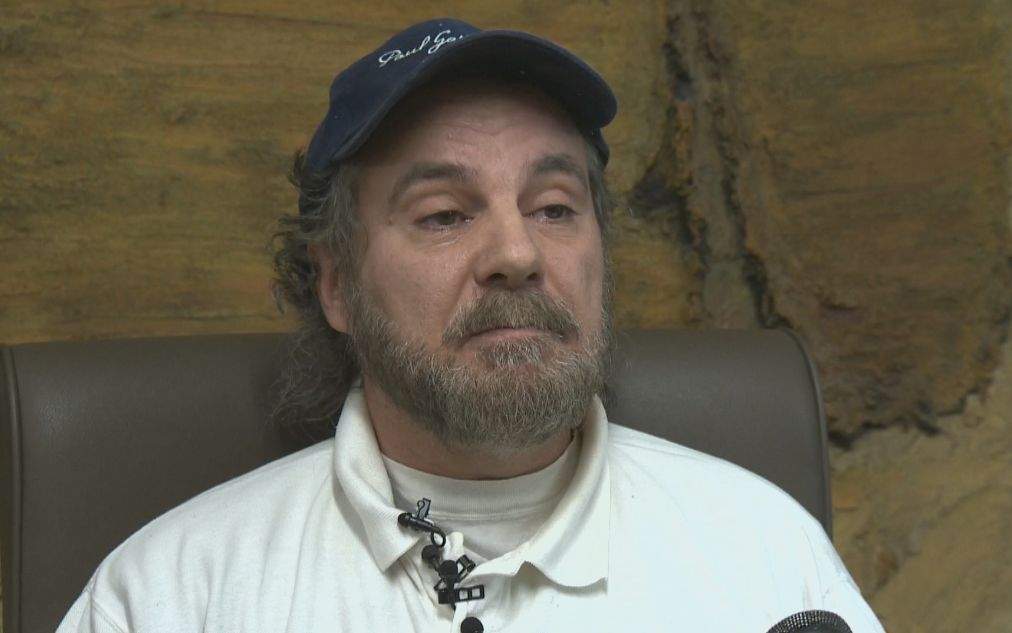
REGINA – Born in Quebec, Edmonton truck driver, Gilles Caron has lived in Alberta for two decades. Although he only moved from another part of the country, it has not been an easy adjustment.

“I travelled for work, I came to Alberta, and I felt like, a shock, that this wasn’t Canada anymore,” he said in a press conference held last Friday in Edmonton in response to his battle over Alberta’s language laws and a decision by the Alberta Court of Appeal.
In 2003, Caron was issued a minor traffic ticket for an illegal left hand turn in English. Caron argued that violated his language rights, and a provincial judge agreed.
The Alberta government successfully appealed in Queen’s Bench; then the case was brought to the Alberta Court of Appeal in April of last year. Last week – after more than 10 years of fighting, Alberta’s top court ruled against him. However, Caron is not giving up: he and his legal team now hope to take the case to the Supreme Court.
“I think he was legitimately surprised when he moved to Alberta 20 years ago – and when he started this he had been in Alberta for 10 years, and he had assumed that Canada had bilingual laws everywhere,” said Caron’s lawyer Roger Lepage with Miller Thomson Lawyers in Regina.
In Alberta and Saskatchewan, current laws allow for French trials in criminal cases, but not civil. Caron wants both provincial governments to embrace bilingualism in all their laws, assemblies and courts.

Get breaking National news
“They have a duty to serve the French community in a legal way (with) certain laws translated to French. And also, when French people want to, for example, file a divorce, a marriage license or some civil documents that they are allowed to file it in French,” said Caron.
While they won’t find out if the Supreme Court will hear their case until mid-April, Caron and Lepage are optimistic. Lepage also pointed out the Supreme Court has already reviewed part of this case when it ordered the Alberta government to pay some of Caron’s legal expenses to continue his appeal.
However, Lepage will have to convince Canada’s highest court of a constitutional basis for language rights in Western Canada and that won’t be easy. Caron is not the first crusader of language rights on the prairies: in 1980, Father Andre Mercure of Saskatchewan received an English-only speeding ticket. Eight years later, Supreme Court justices ruled that when Saskatchewan became a province in 1905, it was still guided by the the Northwest Territories Act Section 110, which upheld bilingualism from when it was a part of Rupert’s Land and the Northwest Territories.
However, the justices added this section of the act was not constitutionally-protected and the province could quickly pass an amendment declaring itself English only (if it did so in both official languages). Both Saskatchewan and Alberta passed amendments that same year. So, in order to have Caron’s case heard, he will have to present different, stronger arguments. Lepage was one of the two lawyers who represented Mercure. This time around, they’ve hired researchers and pored over as many related documents as they could. They now believe three documents in particular will prove their argument.
- Fears are widespread about data centre impacts on Canada’s water, environment: poll
- N.S. crews continue battling out-of-control wildfire northeast of Halifax
- Osoyoos Band seeks return of sacred sites in discussions with B.C. government
- Record turnout expected for Penticton Peach Classic Triathlon, boosting local economy
-
![]() ‘We’re on standby’: Defence Minister McGuinty asked about feds’ role in Ontario wildfire aid
‘We’re on standby’: Defence Minister McGuinty asked about feds’ role in Ontario wildfire aid -
![]() US Ambassador Pete Hoekstra on Trump’s latest threats over wildfire smoke
US Ambassador Pete Hoekstra on Trump’s latest threats over wildfire smoke -
![]() What comes next for Canada after the July CUSMA review
What comes next for Canada after the July CUSMA review -
![]() Canada, Mexico downplay concerns over Chinese EVs ahead of CUSMA review with U.S.
Canada, Mexico downplay concerns over Chinese EVs ahead of CUSMA review with U.S.


In 1867, the Government of Canada was interested in annexing the land which is now Saskatchewan, Alberta, Manitoba and the territories. They sent two addresses to the British Parliament, guaranteeing the area’s inhabitants – 50 percent of whom were francophone – civil and religious rights, including language rights. In 1869 , the British Parliament issued the Royal Proclamation, which later included four bills of rights, all of which guaranteed bilingual laws. And in 1871, the Constitution Act spelled out how the government of Canada could form new provinces. It too guaranteed language rights.
Roger Lepage says it shouldn’t take a Supreme Court ruling at all and Saskatchewan shouldn’t be afraid of bilingualism.
“The world won’t come to an end. It’s not that expensive,” he said. “We base it on historical constitutional documents, but I’m saying this is a looking-forward approach because let’s face it, Saskatchewan and Alberta have at least between five and eight percent of their population who speak both French and English. We have French language schools for the francophone population. We have immersion schools for the anglophones who want to learn French as a second language, so why go through all that expense if we’re not going to allow people to use it?”
Caron’s family was one of the first to settle in Canada hundreds of years ago. So even after all the years he’s spent fighting for what he believes are his rights as a Canadian, he says the battle is worth continuing: “By name it was Canada, but we were treated different here – I was treated different here. But I think of my dad a lot when I keep going.”


Comments
Want to discuss? Please read our Commenting Policy first.