

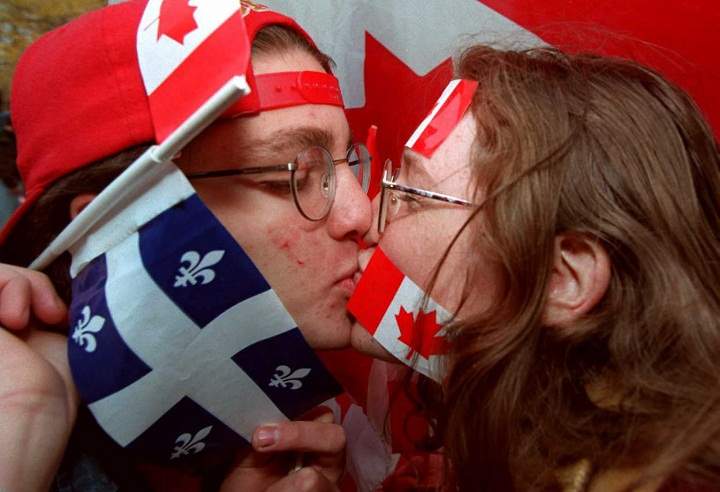
OTTAWA – “Bof” – that francophone shrug of indifference might very well sum up the feeling of most Canadians vis-a-vis the Quebec election campaign.

But federal leaders are paying close attention to an outcome that could play into the general election next year.
READ MORE: Marois: Rest of Canada would be welcome to visit independent Quebec
The possibility of a new sovereignty push might suddenly get Canadians dialled into the national unity debate.
Opposition strategists are quick to caution that a Parti Quebecois victory is no sure thing, and by extension, another sovereignty referendum is a major “what if.”
All leaders are loath to get directly involved in the campaign itself.
READ MORE: Fed politicians tiptoe around Quebec election
Still, there are calculations being considered about how to position each of the leaders as the most capable of keeping the country together.
The NDP’s early gambit appears to be underlining that the party has the most federal seats in Quebec, and that its leader Tom Mulcair comes out in the polls as the most popular federal leader there.
As for the Liberals, they have waded deeper into the Quebec campaign than their rivals, declaring support for the provincial Liberals.
They also like to point out that the NDP have supported a simple majority of 50 per cent plus one for Quebec secession, as opposed to the “clear majority” described in the federal Clarity Act.
Get daily National news
READ MORE: Pierre Karl Peladeau will run for PQ in Quebec election
The fact Stephen Harper once also supported a simple majority as a Reform party MP has not escaped their notice, nor has a seemingly friendly relationship between the prime minister and Quebecor mogul-turned-PQ-candidate Pierre-Karl Peladeau.
The Liberals would portray themselves as hard-line federalists, with no time to “play footsie” with soft nationalists.
“It’s going to be a major fault line,” said one Liberal adviser about the unity issue should Marois win.
Separation and Western Canada
But does Quebec and related unity issues even pierce the consciousness of Canadian voters west of Ottawa anymore?
The conventional wisdom used to be that Ontarians in particular wanted national leaders who could keep Quebec happy.
On Tuesday, a group calling itself the Special Committee for Canadian Unity called on federal leaders to intervene in the Quebec election.
One of the committee’s members is Conservative Alberta MP Peter Goldring.
Ipsos Public Affairs CEO Darrell Bricker, co-author of the book The Big Shift: The Seismic Change in Canadian Politics, argues that the country has changed so dramatically that the dramas of Quebec are just not relevant to wide, influential swaths of the electorate – the swaths that brought Harper to power.
- Osoyoos Band seeks return of sacred sites in discussions with B.C. government
- Record turnout expected for Penticton Peach Classic Triathlon, boosting local economy
- Mom and 1-month-old baby missing in northern B.C., not seen since July 9
- Hoekstra says Trump serious about tariff threat over wildfire smoke


READ MORE: Quebec premier breathes new life into sovereignty movement
“The last national unity debate was in 1995. Since then we’ve added two new Torontos worth of immigrants, most of them have moved to the 905 (around Toronto) and Western Canada,” said Bricker.
“They’ve changed most things about Canadian politics as a result. Quebec has changed as a result of this, and the rest of Canada has changed.”
Bricker says that more than anything, leadership will be what voters seek, rather than a specific Quebec approach.
On that score, he says Harper will play that up in the key battlegrounds of the Greater Toronto Area and points west, but so too will Trudeau.
“It’ll not be a technical evaluation of their positions (on Quebec) or anything, but it will be who do you trust more to deal with this in a way you want to have it dealt with,” said Bricker.
Unity in Quebec?
Matthew Mendelsohn of the Ontario think-tank the Mowat Centre agrees that the province has gone through some major changes in the last two decades, with many residents having no connection to the unity debates of the past.
But he said there are still substantial numbers of Ontarians who continue to care deeply about national unity, too many to dismiss.
That means should Marois win, and should she get the referendum machine in gear, the federal leaders will be expected to put solutions on the table.
“Canada does not exist without Quebec. Quebec might exist, but there is no English Canadian nation. That doesn’t mean you can’t reform something that stretches from Atlantic Canada to parts west of Quebec,” said Mendelsohn.
“If this were to become a real scenario, Canadians would start to think about that.”


Comments
Want to discuss? Please read our Commenting Policy first.