


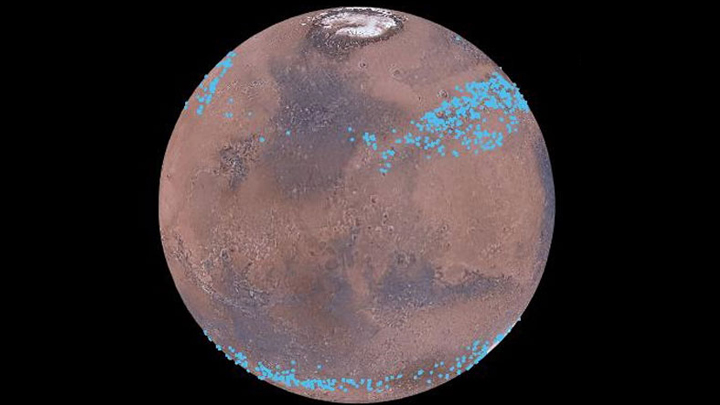
TORONTO – We have known that Mars has polar ice caps for a long time. But now a research paper has concluded that, beneath the thick dusty surface, lies frozen water in the form of glaciers.

Earlier studies found thousands of glacier formations sporadically around the planet. However, two things weren’t completely understood: if they were comprised of water ice (rather than carbon dioxide, for example), and how much there was.
READ MORE: Curiosity rover detects nitrogen, supports research that Mars was once habitable
Using radar, a research team from the Niels Bohr Institute at the University of Copenhagen found that belts of water ice in the form of glaciers lie beneath the thick dust at the planet’s central latitudes in both the northern and southern hemispheres. And they estimate the size to be significant.
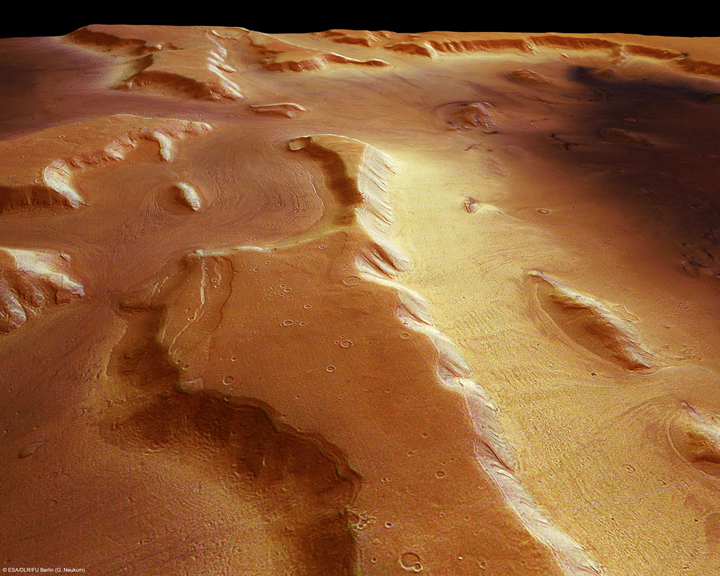
“We have calculated that the ice in the glaciers is equivalent to over 150 billion cubic metres of ice — that much ice could cover the entire surface of Mars with 1.1 meters of ice. The ice at the mid-latitudes is therefore an important part of Mars’ water reservoir,” said Nanna Bjørnholt Karlsson, postdoctoral researcher at the Centre for Ice and Climate at the Niels Bohr Institute where the research was conducted.

Get breaking National news
It is known that water was once abundant on Mars but where it went is still not completely understood. There are theories that much of it evaporated or ended up in the ground, though how much ended up there is unknown.
- Calgary area ‘very uniquely situated’ for study of hailstorms, says researcher
- New Asia Highlands exhibit, with some new species, opens at the Calgary Zoo
- Scientists find sugar in the Milky Way. It could help answer a cosmic mystery
- Meta to build $13 billion data centre in Alberta, largest outside the U.S.


If glaciers do indeed exist below the dusty surface, this is good news: Humans will need to have access to water should we settle on the red planet. And dragging it there from Earth is costly.
The research was published in the scientific journal Geophysical Research Letters


Comments
Want to discuss? Please read our Commenting Policy first.