



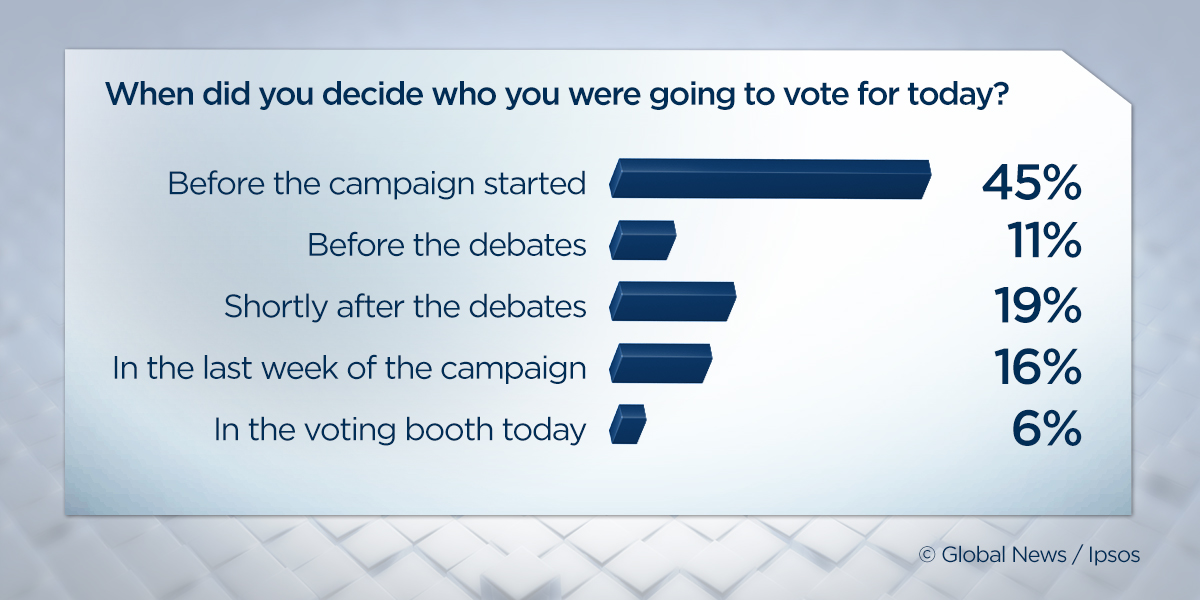
As Canadians cast their ballots in the 42nd general election Monday an exclusive survey conducted by Ipsos has found almost half of voters made the decision on which party they were going to vote for before the election campaign began.

The Election Day survey conducted on behalf of Global News found that 75 per cent of respondents had made up their minds prior to Oct. 19 with 45 per cent deciding prior to the campaign, 19 per cent shortly after the debates and 11 per cent before the debates.
READ MORE: Which party leaders could lose their jobs after results come in?
Twenty-five per cent of respondents were late deciding on their ballot with 16 per cent saying they made their decision in the last week of the campaign and four per cent actually deciding in the voting booth, the survey found. Three per cent said they were unsure when exactly they made a choice.
The Ipsos election survey asked just over 8,000 respondents a series of questions about their voting preferences; including when they decided on who they would vote for and whether this was their first federal election voting in.
As Canada’s 78-day marathon campaign came to an end today the Liberals have a small lead over the Conservatives. The NDP, who began the campaign out front, now sit in third place, according to seat projections released by the Laurier Institute for the Study of Public Opinion and Policy (LISPOP) on Sunday. The findings suggest the Liberals are in the lead but still 30 seats away from the 170 seats needed for a majority government.

Get daily National news
This has been one of Canada’s closest elections with all three parties leading in the polls at one point over the course of the 11-week campaign. Several unexpected hot-button issues emerged on the campaign trail, including the niqab debate and questions on Canada’s response to the Syrian refugee crisis.
- Osoyoos Band seeks return of sacred sites in discussions with B.C. government
- Record turnout expected for Penticton Peach Classic Triathlon, boosting local economy
- Mom and 1-month-old baby missing in northern B.C., not seen since July 9
- Hoekstra says Trump serious about tariff threat over wildfire smoke


Sean Simpson, a vice-president with Ipsos, says this election was different from the last 2011 election because there wasn’t one pivotal turning point.
“We have more voter volatility in Canada than in most other countries,” said Simpson. “Almost half of Canadians had their minds made up before the election. So whether it was a 60 day campaign, a 90 day campaign it didn’t matter.
LIVE: Global News has live coverage and real-time results after the polls close
Roughly 3.6 million Canadians cast their ballots in advance polls – up 71 per cent for the 2011 election, Election Canada said.
According to the Ipsos survey, there were just three per cent of new voters Monday at the voting booths.
When asked “is this the first Federal Election you have ever voted in?” an overwhelming 94 per cent said no, while five per cent said this was their first election.
Polls opened at 9:30 a.m. ET in eastern Canada, at 8:30 a.m. local time in central Canada, at 7:30 a.m. MT in the Rockies, and at 7 a.m. PT on the West Coast. Global News will have live coverage as Canadians decide who will be the next Prime Minister.


Comments
Want to discuss? Please read our Commenting Policy first.