


Hundreds of thousands of people in Canada have a more than neighbourly interest in Nov. 8’s U.S. elections — they’re eligible to vote.

Unlike Canada, which cuts off voting rights for people who have been out of the country for more than five years, the United States lets citizens living abroad vote from their last U.S. address for the rest of their lives.
(On the other hand, U.S. citizens abroad must file tax returns and in many cases register for the draft.)
Most states also let never-resident citizens, born with a U.S. citizen parent abroad, vote from their parent’s last address, though many restrict them to voting for federal offices only. Federal offices will include the presidency, and may include races for the U.S. Senate and House of Representatives.
If you want to vote in November, you need to keep track of two deadlines in the state where you’re eligible to vote: the deadline to register to vote, and the deadline in that state to request an absentee ballot. A number of states have voter registration deadlines in the second week of October, so starting the paperwork soon is a good idea.

Here’s an interactive tool to find the deadlines in the state where you plan to vote.
Two sites help you fill out voter registration paperwork online, tailored to the specific state concerned:
- The Federal Voting Assistance Program, a resource for U.S. voters outside the country, run by the Pentagon
- The Overseas Vote Foundation, a non-profit organization

Get daily National news
Some states will send absentee voters, even never-resident absentee voters, a complete ballot covering federal, state and local offices. American Citizens Abroad warns that voting at the state and local level may expose you to state and local taxation, so you may want to seek advice in this area.
If you’d like to talk to local election officials, a complete directory is here.
READ MORE: Some U.S. liberals walk the walk: immigration to Canada doubled after Bush’s 2004 re-election
Common sense says that getting an absentee ballot and returning it well in advance of the deadline would be a good idea, given that a local election office has to mail it to Canada, and it has to make its way back to them on time.
Massachusetts, for example, will accept absentee ballot requests right up until noon on Monday, Nov. 7, but the ballots are due on Election Day — the next day.
Some states require a photocopy of your U.S. passport mailed with your ballot package.
If you don’t get a ballot in time, you may want to make use of the federal write-in absentee ballot. Here’s how that process works:
How many U.S. citizens are there in Canada? It varies, depending on who’s counting.
The U.S. State Department estimates that there are about a million, but the 2006 census found about 300,000 people living in Canada who were U.S. born, of whom about 100,000 said they only had Canadian citizenship. (Before a U.S. Supreme Court decision in 1980, the U.S. didn’t recognize dual citizenship — Americans who took on another citizenship automatically stopped being American whether they wanted to or not.)
- Osoyoos Band seeks return of sacred sites in discussions with B.C. government
- Record turnout expected for Penticton Peach Classic Triathlon, boosting local economy
- Mom and 1-month-old baby missing in northern B.C., not seen since July 9
- Hoekstra says Trump serious about tariff threat over wildfire smoke


The census didn’t ask Canadian-born people about their second citizenships. In most cases, people born in Canada with a U.S. citizen parent are legally U.S. citizens, but the U.S. may not know about their existence if they haven’t asserted a claim to citizenship.
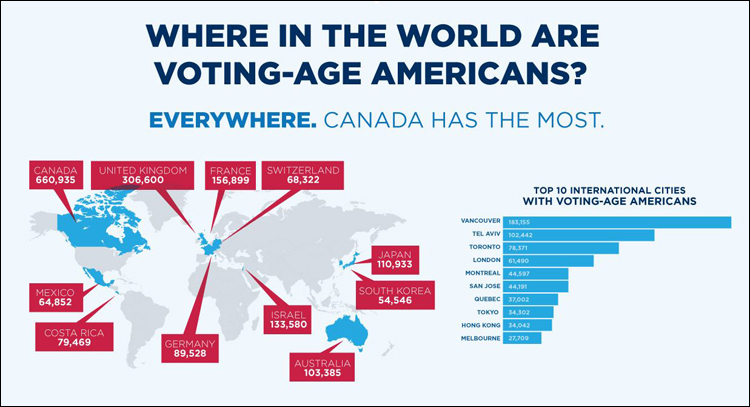
Nonetheless, FVAP estimates that 660,935 people in Canada are eligible to vote in U.S. elections, and that of the top 10 non-U.S. cities for voting-age Americans, four are in Canada (1: Vancouver; 3: Toronto; 5: Montreal; 7: Quebec City).
Based on that number, FVAP says that Americans in Canada had a 2.5 per cent voter turnout in 2014.

People with U.S. status in Canada vary from short-term expatriates to long-term residents who have been here for decades, to Canadians who were born in the U.S. for accidental reasons and live only as Canadians.
Attitudes to U.S. status vary as well. In recent years, growing numbers of U.S.-Canadian dual citizens have gotten rid of their U.S. citizenships due to tax rules that are both complex and, increasingly, strictly enforced.
If you are thinking of doing this, be aware that voting in a U.S. election may work against a claim that you relinquished U.S. citizenship through some prior act such as taking on Canadian citizenship. For example, this State Department form used to evaluate loss of citizenship asks whether you have voted in U.S. elections.
We explained the issues involved in more detail here.



Comments
Want to discuss? Please read our Commenting Policy first.