


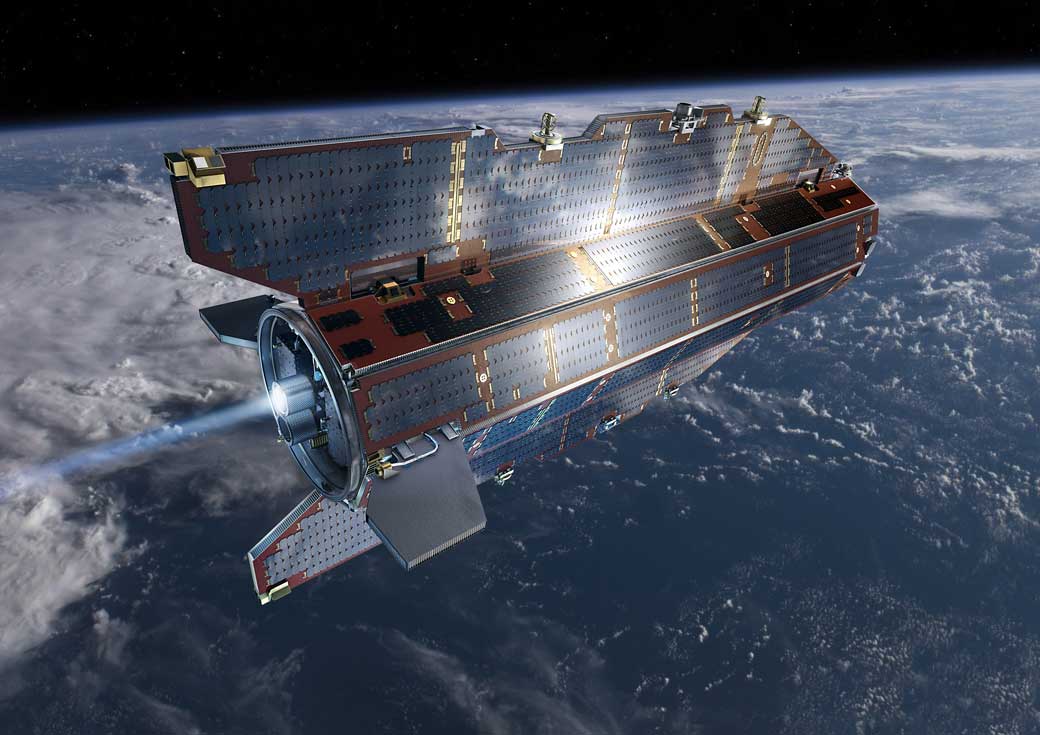
TORONTO – If you see something streaking across the sky sometime in the next day or so, you may be witnessing the fiery death of a satellite.

The European Space Agency’s (ESA) Gravity field and steady-state Ocean Circulation Explorer (GOCE) satellite is ready to make an uncontrolled entry into Earth’s atmosphere in about a day. However, nobody knows where the satellite will end up.
But, to quote author Douglas Adams: “Don’t panic.”
The chances of it dropping on your head are remote. For one, Earth is over 70 percent water. Secondly, there are large uninhabited parts of the world.
ESA says that the 1,100 kg satellite has already fallen to an altitude of 160 km. Once it reaches an altitude of 80 km, most of the satellite – about four-fifths – will burn up in our atmosphere.
- Calgary area ‘very uniquely situated’ for study of hailstorms, says researcher
- New Asia Highlands exhibit, with some new species, opens at the Calgary Zoo
- Scientists find sugar in the Milky Way. It could help answer a cosmic mystery
- Meta to build $13 billion data centre in Alberta, largest outside the U.S.


GOCE was launched in 2009 to map the Earth’s gravitational field. It ran out of fuel last month, ending the mission.

Get breaking National news
This isn’t the first time satellite debris has crashed to Earth. The most recent uncontrolled entry was the failed Russian Phobos-Grunt satellite in 2012. After a malfunction, the satellite that was headed to Mars failed to leave Earth’s gravity and crashed into the Pacific Ocean.
On Friday, the ESA said that we are 250,000 times more likely to win the lottery than to get hit by the debris.
Now quick: go out and buy your lottery ticket.
–with files from The Associated Press


Comments
Want to discuss? Please read our Commenting Policy first.