

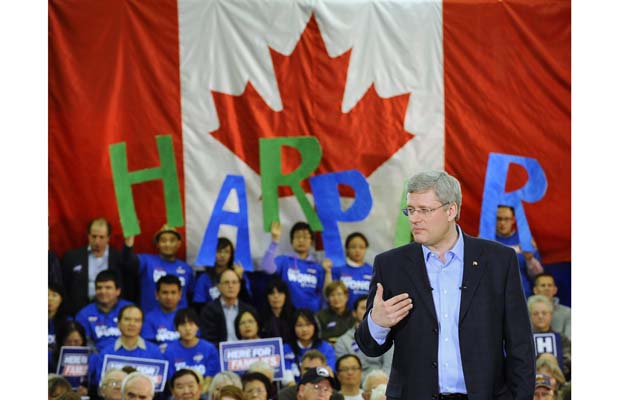
YELLOWKNIFE – Stephen Harper’s vision of a strong and free Far North ran up against northern reality Monday.
Even as he reannounced a promise to complete an all-season highway in the Arctic, he said funding a drug treatment centre for poor and addicted northerners isn’t a promise he should make.
"In terms of specific infrastructure investments that need to be made in this area, I always say during a campaign, I don’t make the local commitments. That’s up to individual candidates to make and to bring those priorities to Ottawa," Harper said in answer to the only question he took from a northern reporter.
But, he said, if voters in this sprawling Western Arctic constituency elect Tory candidate Sandy Lee, an ex-territorial health minister, maybe she could bring the plan for one to Ottawa.
First, Lee would have to unseat NDP incumbent Dennis Bevington, whose seat is being targeted by the Tories on this trip to Yellowknife.
Bevington was one of the only NDP MPs to vote with the Tories last fall on a bill to scrap the long-gun registry. The bill failed to pass.
Harper was asked the question about the drug-treatment centre in the context of the Tories’ tough-on-crime platform.
Crime rates in the North are far higher than elsewhere in the country and substance abuse is a widespread problem.
Harper said his government’s national drug strategy is based on prevention and treatment and there is also a plan to treat drug-addicted prisoners.
Harper said his northern strategy also contains significant investments in economic development.
"It is true there remains social challenges, but the biggest step forward is jobs for people," Harper said, noting that his government has increased transfers to the territories for health care, social programs and education.
Christine Wenman, who joined a small group of protesters in the frigid early morning outside Harper’s hotel, said she wished Harper had been more publicly available to discuss serious issues facing northerners.
"We have some questions for him. There’s not an opportunity while he’s in Yellowknife to have a public forum so that seems quite indicative of how he’s been running this country the last few years. We’d like to see a little bit more open debate and a lot more transparency," she said.
Wenman would have like to ask Harper about what he’s doing to protect the Arctic’s pristine environment.
Earlier Monday, Harper reached back to the 1950s vision of John Diefenbaker to promote Conservative election hopes in the Great White North.
Harper reiterated a $150 million promise to complete the final 140-kilometre stretch of the Dempster Highway joining Inuvik and Tuktoyaktuk.
Harper says the project is of historic significance and completes the dream of Diefenbaker – known as The Chief – who wanted the country connected from sea to sea to northern sea.
Liberal Leader Michael Ignatieff is also mining for votes in the diamond capital of North America, a sign of the riding-by-riding trench warfare in advance of the May 2 general election.
There are less than 70,000 eligible voters spread across Canada’s Arctic and its three federal seats – fewer voters than can be found in a 15-block radius of many big-city ridings.
But all the northern seats – Western Arctic, Yukon and Nunavut – have a history of swinging among the Conservatives, Liberals and NDP, making them ripe territory for campaigning leaders.



Comments
Want to discuss? Please read our Commenting Policy first.