

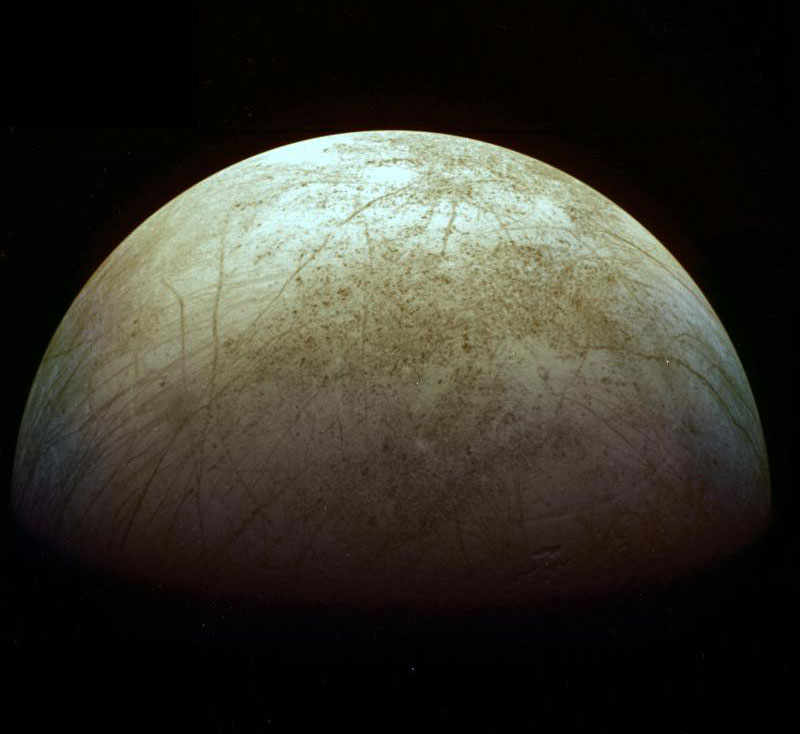
WASHINGTON – NASA is plotting a daring robotic mission to Jupiter’s watery moon Europa, a place where astronomers speculate there might be some form of life.

The space agency set aside $15 million in its 2015 budget proposal to start planning some kind of mission to Europa. No details have been decided yet, but NASA chief financial officer Elizabeth Robinson said Tuesday that it would be launched in the mid-2020s.
READ MORE: In photos: Science and art come together on Mars
Robinson said the high radiation environment around Jupiter and distance from Earth would be a challenge. When NASA sent Galileo to Jupiter in 1989, it took the spacecraft six years to get to the fifth planet from the sun.

Get daily National news
Rensselaer Polytechnic Institute astronomer Laurie Leshin said it could be “a daring mission to an extremely compelling object in our solar system.”
Past NASA probes have flown by Europa, especially Galileo, but none have concentrated on the moon, one of dozens orbiting Jupiter. Astronomers have long lobbied for a mission to Europa, but proposals would have cost billions of dollars.
- Calgary area ‘very uniquely situated’ for study of hailstorms, says researcher
- New Asia Highlands exhibit, with some new species, opens at the Calgary Zoo
- Scientists find sugar in the Milky Way. It could help answer a cosmic mystery
- Meta to build $13 billion data centre in Alberta, largest outside the U.S.


Last year, scientists discovered liquid plumes of water shooting up through Europa’s ice. Flying through those watery jets could make Europa cheaper to explore than just circling it or landing on the ice, said NASA Europa scientist Robert Pappalardo.
NASA will look at many competing ideas for a Europa mission, so the agency doesn’t know how big or how much it will cost, Robinson said. She said a major mission goal would be searching for life in the strange liquid water under the ice-covered surface.
Harvard University astronomer Avi Loeb said going to Europa would be more exciting than exploring dry Mars: “There might be fish under the ice.”


Comments
Want to discuss? Please read our Commenting Policy first.