


Eleanor Doney’s daughter is perplexed, upset and still grief-stricken from the senseless murder of her elderly mother.

After the 14-year-old boy who fatally stabbed her mother was sentenced to the maximum youth sentence for first-degree murder, Judy Kirwin read a statement outside the Oshawa courthouse on Wednesday, explaining her frustration with the Youth Criminal Justice Act (YCJA) and a Supreme Court decision.
That ruling precludes youth, like the teenager who brutally attacked her mother in a planned and unprovoked manner, from being sentenced as an adult.
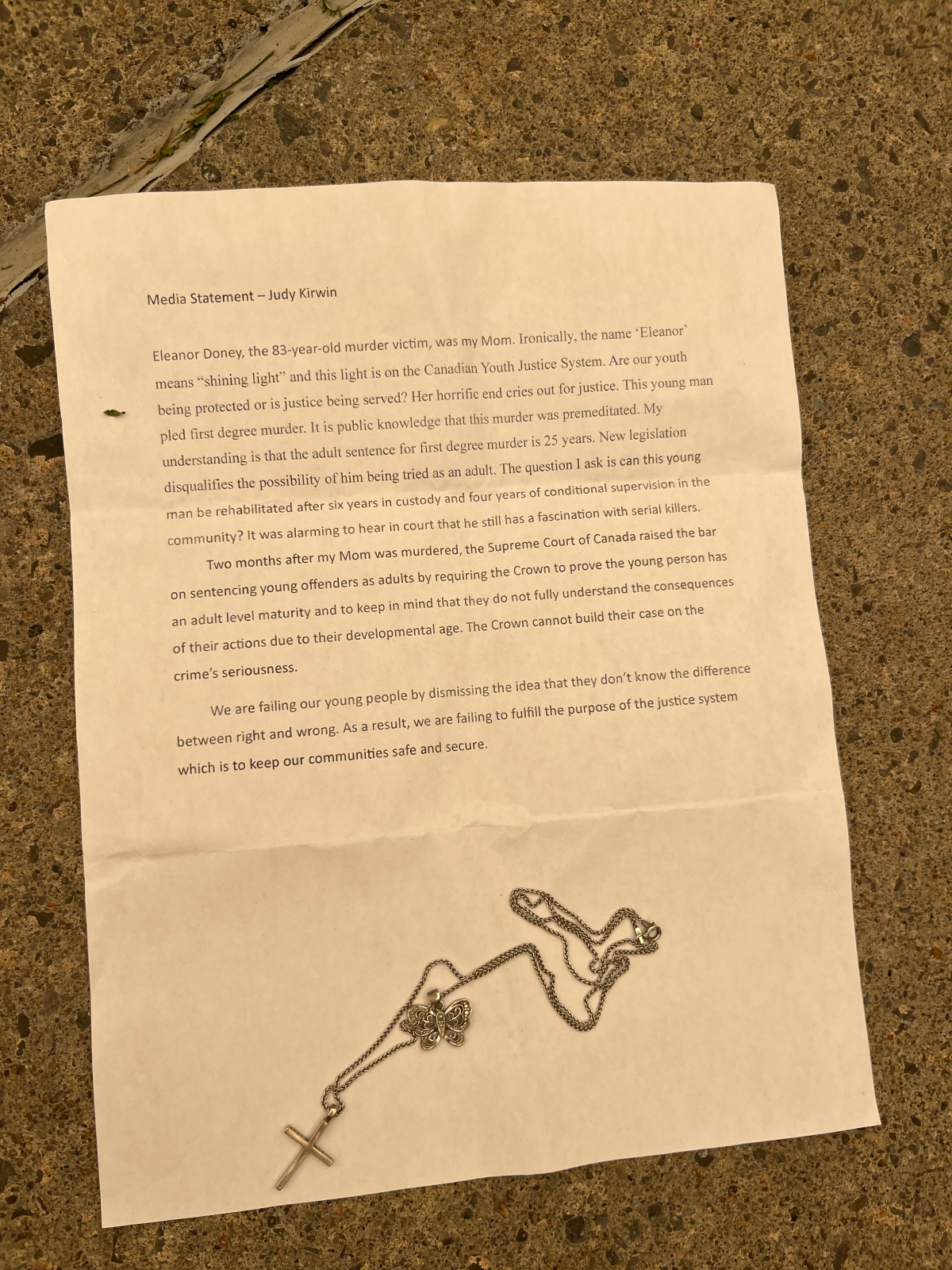
“Eleanor Doney, the 83-year-old murder victim, was my mom. Ironically, the name ‘Eleanor’ means ‘shining light,’ and this light is shining on the Canadian Youth Justice System. Are our youth being protected, or is justice being served?” she asked.
“Her horrific end cries out for justice. This young man pleaded to first-degree murder. It is public knowledge that this murder was premeditated. My understanding is that the adult sentence for first-degree murder is 25 years. New legislation disqualifies the possibility of him being tried as an adult.
“The question I ask is, can this young man be rehabilitated after six years in custody and four years of conditional supervision in the community? It is alarming to hear in court that he still has a fascination with serial killers.”
She questioned a Supreme Court decision from July 2025, two months after her mother’s murder, which said that, in order to sentence as an adult, the Crown must prove beyond a reasonable doubt that the young person has the moral maturity and capacity equivalent to an adult at the time of the offence.
“We are failing our young people by diminishing the idea that they don’t know the difference between right and wrong,” Kirwin said. “As a result, we are failing to fulfill the purpose of the justice system, which is to keep our communities safe and secure.”
Superior Court Justice Lisa Wannamaker sentenced the teen, known as A.S., to the maximum sentence jointly agreed upon by Crown and defence: six years in custody followed by four years to be served in the community under a supervision order. Wannamaker also credited A.S. with one year for time already served since his arrest.
A.S.’s identity is covered by a publication ban due to the YCJA.

Get breaking National news
Wannamaker said that A.S., who is now 15, will serve an Intensive Rehabilitative Custody and Supervision sentence, which has been specifically developed to meet the needs of a violent youth offender with mental health issues.
The judge said he meets the necessary criteria and has agreed to participate.
“A plan has been developed to reduce the risk of recidivism,” Wannamaker said.
She pointed out that while A.S. continues to show a preoccupation with themes of violence, specifically to harm others, and a fascination with serial killers, he has demonstrated increased insight and openness to therapeutic options.
The court heard that A.S. has begun Grade 9 since being arrested more than a year ago, has completed five credits with marks in the 80s and 90s, and has completed more than 45 community involvement hours.
“Since being there, he has shown strength in verbal communication skills and started engaging in extracurricular activities, which he has never done before,” Wannamaker said.
In reviewing A.S.’s personal circumstances before the murder, Wannamaker told the court that his family immigrated to Canada from Pakistan in the 1970s and 1980s, first his father, then his mother. He is the youngest of four children. His father moved to the United States for work when A.S. was approximately five years old and would visit the family home every five to six weeks.
The court also heard that A.S. had to share a room with his grandmother from the age of 12, which was a strained relationship because she only speaks Urdu. There was also conflicting information about a history of family discord.
His parents reported he was a happy and talkative child and reported he transitioned to elementary school with ease, denying any academic difficulty in his elementary school years.
“In contrast to some reporting from school records and school staff. In Grade 5, it was observed that he began wearing the same distinctive outfit daily. A black suit, a black trenchcoat and a briefcase. He had selected this outfit based on a combination of characters he admired related to the media. Patrick Bateman from American Psycho and Yoshikage Kira from an anime series,” Wannamaker told the court.
Wannamaker said while A.S. had been suspended for the first time from school after being caught with a knife just a day before Doney’s murder, he said he had been carrying the knife for a few weeks prior, for his protection. There was also a considerable amount of absenteeism during his Grade 8 year.
- Video captures distraction theft from an 88-year-old woman in East Vancouver
- Ontario woman pleads guilty to defrauding Taylor Swift fans out of $265K in ticket scam
- Driver accused of deliberately hitting Muslim woman due to race: Edmonton police
- 2-year-old shot, killed by 4-year-old with unsecured gun left in car: police


In one report prepared in anticipation of sentence, A.S. disclosed he had experienced fluctuations in violent ideations, which he described as an urge to kill in the weeks preceding the incident.
Wannamaker cited from one report done in March 2026, in which a psychiatrist found that throughout his youth, it was recommended that he be evaluated by a developmental pediatrician to assess possible medical challenges but that was never done. Since his incarceration, the psychiatrist found that he has highly engaged in school and has been described as “their best student”. It was noted that he has a positive attitude and does not miss class.
The psychiatrist diagnosed A.S. with a non-verbal learning ability and found he met the criteria for autism spectrum disorder.
“In the months preceding the offence, he likely met the criteria for a diagnosis of major depressive disorder with psychotic features,” said Wannamaker. “A.S. discussed a willingness, even enthusiasm, for therapy, saying he believes it is essential to make sure it doesn’t happen again,” she said.
“It is noted that his delusional thought process and disorganized thinking remain and he needs to be followed and assessed with regards to psychotic illness. Ongoing psychiatric involvement is needed to mitigate risk,” Wannamaker added. “His participation in individual therapy is key with a focus on violence specific treatment.”
Wannamaker said there is no disputing that he attacked a defenceless, innocent senior citizen on the front lawn of her home, which has had a profound and lasting impact on the family and the community, noting his degree of responsibility is high.
“He acted alone, and he pre-planned this attack,” she said. “While he has shown deficits in remorse and accountability, they appear to be linked to his mental health diagnosis and therefore they are amenable to treatment and rehabilitation.”
Before A.S. was led away to begin serving the five-year custodial sentence he has remaining, the judge addressed him directly.
“I sincerely hope you that truly meant the comments you made to Ms. Doney’s family and to the court yesterday, and you understand the consequences of your actions, at least minimally at this time. I hope it has motivated you to change and not let this terrible circumstance and tragedy define you, as you put it,” Wannamaker said, urging him to remain committed to his therapy and plan.
Doney’s son-in-law told Global News he’s hopeful the treatment plan works.
“If he’s rehabilitated, with the experience he has and what he’s gone through, maybe he can make a huge difference in the community. I wish the best for him, I really do,” said Peter Kirwin.
He also believes the murder could have been prevented had more been done to help A.S.
“He was suspended the day before the murder took place, so what was he suspended for? Was he suspended in somebody else’s custody, or was he suspended just to go walk the street with a knife? How did he get the knife to commit the murder with? Did he get that at home still, after he was suspended with a knife? What precautions were taken?” said Kirwin.
Kirwin said the community has been rocked by Doney’s murder.
“Something’s got to happen to protect the community and to bring back safety. Hopefully, maybe there can be an inquest to what’s going on. That would be something we’d like the politicians to look at and can be promoted because we do want to prevent other senseless murders.”


Comments
Comments closed.
Due to the sensitive and/or legal subject matter of some of the content on globalnews.ca, we reserve the ability to disable comments from time to time.
Please see our Commenting Policy for more.