


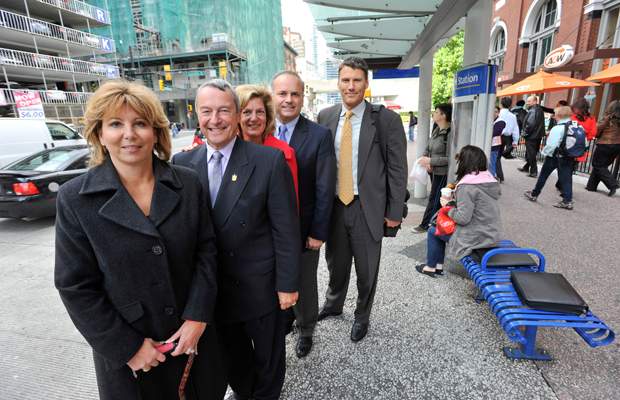
METRO VANCOUVER — Seven Metro Vancouver mayors, including those in Surrey and Vancouver, will vote in favour Friday of boosting the gas tax – and potentially raising property taxes – to pay for regional transit projects.

The mayors, who represent more than 70 per cent of Metro’s population, say they expect their support will result in approving TransLink’s controversial funding plan, despite opposition from Richmond and Burnaby.
Those two cities, along with Vancouver and Surrey, hold the most votes on the regional mayors’ council on transportation. But Vancouver and Surrey also have the support of Coquitlam, Port Coquitlam, Langley City, West Vancouver and North Vancouver District.
“It comes down to funding issues of trust and working together … we’re at a critical juncture,” Langley City Mayor Peter Fassbender told a Vancouver Sun editorial board meeting Tuesday. “We believe we will have a majority of support to move ahead.”
The proposed funding supplement calls for a two-cents-a-litre boost in the gas tax as well as potential property tax increases in 2013-14 if alternative funding sources, such as road-congestion charges, vehicle levy or carbon tax revenue, can’t be secured to pay for future transit projects.
The money would be used to build the long-awaited Evergreen Line as well as for major improvements to SkyTrain stations at Metrotown, Main Street, Surrey Central and New Westminster and the Lonsdale SeaBus terminal; a new B-Line bus route along King George Highway from White Rock to Guildford; more bus routes in south Surrey and Langley; Highway 1 rapid transit from Langley to Lougheed station; and road and cycling improvements.
Get daily National news
“There’s never been a willingness to sit down and toll up our sleeves and work together on this,” Surrey Mayor Dianne Watts said.
She noted it wasn’t easy for the group to advocate for expansion of the transit system, but the group felt they had to start planning for the future both for transit and road expansion for goods movement. Surrey has the second largest border crossing in the country, she said, with 700,000 trucks going between Canada and the U.S. And in the next few decades, 70 per cent of the region’s growth will be south of the Fraser.
“It’s imperative we start planning now. If we do nothing now and do nothing about the future we’re going to be in a mess,” Watts said. “We’re going to see an influx of people; we have to get those cars off the road.”
Calling their joint support an “unprecedented show of strength,” Vancouver Mayor Gregor Robertson said the group decided to work together because of the need for a regional transit plan to provide not only services for transit users but for movement of goods and services.
“There’s pressure on the existing transit system, whether it’s pass-ups on buses in Vancouver or congestion south of the Fraser,” Robertson said. “We simply must invest in a more robust transit system.”
If the plan is accepted, the province will then have to change legislation to allow the increase in the gas-tax funding, while negotiations will continue with the government on other long-term funding sources. The mayors would then work with the province to find alternate new sources of funding for the long-term.
The mayors acknowledged those who rely on their cars, especially south of the Fraser which has limited transit services, will pay more for the transit plan in the short-term, but vowed to look at making the plan for fair equitable across the region. This could include tolling existing bridges and roads and a graduated vehicle levy.
Robertson said people in Vancouver would be willing to pay for the plan because it will provide more access to the rest of the region, while Fassbender said many of the seniors in Langley would like to give up their cars if they had transit to get around.
“We’re going to be paying more but we have more to gain,” Coquitlam Mayor Richard Stewart said.
The mayors said many people are already using transit since the 2010 Olympic Games. Between June 2010 and July this year, there was a 19.6-per-cent spike in transit ridership.
The Evergreen Line, which has been in the works since 1989, was supposed to be operational by 2014. The project has been stalled as TransLink has been unable to come up with its $400-million share of the project, which is being built jointly with the provincial and federal governments.


Comments
Want to discuss? Please read our Commenting Policy first.