


TORONTO – Two years after a powerful earthquake slammed the fragile island nation, the Canadian government is expressing disappointment over Haiti’s plodding reconstruction.

“Generally, I think we’re all disappointed at the rate of progress, that we had expectations (that) have not been met,” International Co-operation Minister Bev Oda said in a recent interview.
“(We’re) disappointed that so many situations have caused delay. Would I have liked to have seen more progress two years later? Absolutely, yes.”
But David Morley, president of UNICEF Canada, says reconstructing and rebuilding takes time.
“You have to think of the rubble in the first place,” says Morley. “The rubble is being removed at the same speed that the rubble was removed from the World Trade Center in New York City. And the rubble in Haiti is a lot bigger.”
According to the United Nations Development Programme, approximately five million cubic metres — or enough to fill five football stadiums — has been removed.
The 7.0-magnitude earthquake that struck on January 12, 2010, reduced much of the capital, Port-au-Prince, to rubble. Exact fatality numbers from the worst earthquake in the region in more than 200 years remains uncertain, but a highly-criticized report released last year by the U.S. Agency for International Development estimated the quake’s death toll was between 46,000 and 85,000 — much lower than the figure of 316,000 cited by Haitian authorities.

Get breaking National news
Neither the Haitian government nor any other international organization have yet to publish a comprehensive report to explain how they arrived at their death toll figures.
Building from the ground up
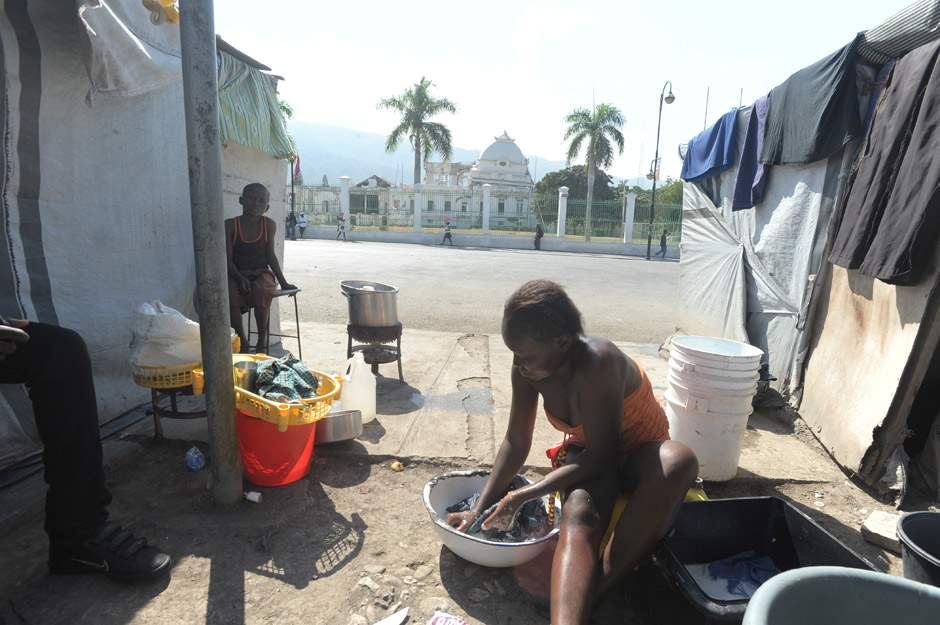
Today, some 500,000 people still live in the squalor and dangers of the encampments. On the first anniversary of the earthquake, one million were living there. But Roger Annis, coordinator of the Canada Haiti Action Network, says the impression that one million people have been re-housed is wildly off-base.
“A portion of the decline in the number of people in the camps is for very disturbing reasons, namely, the re-occupation of condemned or severely damaged homes,” says Annis.
According to the 2011 BARR study, approximately 65 per cent of condemned dwellings and 85 per cent of severely damaged dwellings had been reinhabited by early 2011.
“These reoccupation numbers are even higher today. Sadly, this is a part of the story of the housing and shelter crisis that is virtually absent from the public discourse, undoubtedly because it casts a bad light on the pace and scope of the shelter program overall.”
Annis says a portion of the decline also came from people who left the earthquake zone completely.
On Wednesday, Minister Bev Oda announced that Canada has committed $19.9 million over two years to resettle 20,000 people displaced by the earthquake and restore the Champ de Mars, a major public park in Port-au-Prince.
“Canada is proud to be a part of the international efforts to help Haiti as it recovers from the earthquake over the past two years. We are fulfilling our commitment to the Haitian people so they can move forward to building their communities and their country,” says Oda.
Morley says that the existing housing issues will be difficult to overcome.
“Most of the people that are left were renters and, due to a poor land registry system, it is difficult to know who truly owns land in Haiti,” says Morley.
SIDEBAR: Haiti earthquake: Where did the donated money go? Read it here.
As the shelter crisis persists, Haitians are in the midst of trying to control another dire condition—the cholera epidemic.
Cholera outbreak
In mid-October 2010, a cholera outbreak killed approximately 7,000 and infected over 500,000 others. The disease, which can kill people within hours through dehydration, is caused by bacteria found in contaminated water or food and is easily treatable if caught in time.
Haitians now have the highest cholera infection rate in the world.
Some scientific studies have found that the disease was inadvertently brought to Haiti by a U.N. battalion from Nepal, and spread throughHaiti because of poor sanitation.
“One of the responses that came out of the cholera outbreak has been all kinds of work on improving water and sanitation,” says Morley. In 2011, the first dedicated human waste treatment site was built, which Morley says will ensure greater environmental safety for the disposal of human waste.
More harm than good?
Morley says that often in emergency relief, foreigners can come in and do quick fixes, but there’s a risk that as outsiders they overlook local community groups, because they do not understand the culture.
As NGO contracts continue to end and evictions for temporary displacement camps are being handed out, some wonder whether external organizations in countries like Haiti are doing more harm than good.
“Just as food banks and United Ways in Canada fill in where government fails and create permanent, structural deformations in society, the consequences in Haiti are, of course, far more grave. Does that mean all NGO’s should leave Haiti tomorrow? “Of course not,” says Annis. “That would be a dereliction of duty.”




Comments
Want to discuss? Please read our Commenting Policy first.