

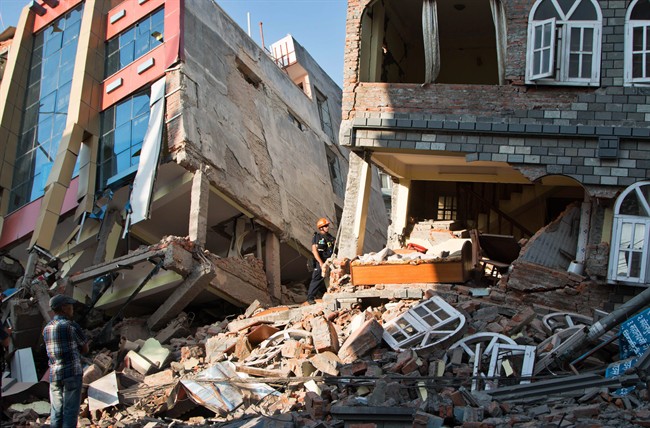
CHAUTARA, Nepal – Officials with bullhorns walked through the quake-damaged streets of this small Nepal town Wednesday, calling for people to leave buildings in danger of falling after a second major earthquake in less than three weeks.

The evacuation orders came a day after Nepal, just beginning to rebuild after the devastating April 25 temblor, was hit by a magnitude-7.3 quake. Tuesday’s earthquake killed at least 65 people, injured nearly 2,000 and caused landslides that blocked roads and slowed the delivery of relief supplies.
“There is danger!” the officials called out over the bullhorns. “Leave the buildings!”
Most people, though, had fled into the open the day before, and had spent the night in tents or under plastic tarps.
READ MORE: Thousands spend night outdoors as death toll rises in Nepal
Tuesday’s quake battered Chautara, a foothills town that became a hub for rescuers and humanitarian aid after the first earthquake. Officials there said at least three people had died Tuesday and more than 60 were injured.
Jamie McGoldrick, a U.N. official in Nepal, said the earthquake had aggravated problems in the areas hit by the earlier temblor.
“Damaged houses were further damaged or destroyed. Houses and schools building spared before were affected yesterday, roads were damaged,” he said Wednesday.
Among 14 quake-hit districts, some are very inaccessible. A large part of population could not be reached easily as roads have been damaged by the earthquake.
“Some are even difficult to reach by helicopter. We are facing monumental challenge here to support the government in these districts to have credible response,” he said.
Meanwhile, a U.S. Marine Corps helicopter carrying six Marines and two Nepalese soldiers was reported missing while delivering disaster aid Tuesday in the country’s northeast, U.S. officials said, although there have been no indications the aircraft crashed.

Get daily National news
READ MORE: Dramatic photos and video from devastated Nepal
Home ministry official Laxmi Dhakal said Wednesday that army helicopters were scouring the Sunkhani area, nearly 80 kilometres (50 miles) northeast of Kathmandu, for the missing helicopter.
The quake struck hardest in the foothills of the Himalayas. Most of the 65 people confirmed dead by Wednesday afternoon were in Dolakha district, northeast of Kathmandu, said the district’s chief administrator, Prem Lal Lamichane.
“People are terrorized. Everyone is scared here. They spent the night out in the open,” Lamichane said, adding the administration was running out of relief material.
He asked the government to send more helicopters and supplies, and said there were many injured people stranded in villages.
Tuesday’s quake also left nearly 2,000 injured, according to the Home Ministry’s latest count. But that toll was expected to rise as reports trickled in from isolated Himalayan towns and villages. Tuesday’s quake also killed 16 in northern India, and one person in Tibet.
The magnitude-7.8 earthquake that hit April 25 killed more than 8,150 people and flattened entire villages, leaving hundreds of thousands homeless in the country’s worst-recorded quake since 1934. The U.S. Geological Survey said Tuesday’s earthquake was the largest aftershock of that quake.


But while the recent quake was terrifying and deadly, it was significantly less powerful than April’s and occurred deeper in the Earth. Working from U.S. Geological Survey data, calculations done by University of Michigan earthquake geophysicist Eric Hetland indicated that about 65,000 people were exposed to “violent” shaking Tuesday – compared to 1.5 million on April 25.
While the first quake exposed just under 8,000 square kilometres (3,100 square miles) to severe shaking, Tuesday’s exposed only about 660 square kilometres (255 square miles) to the same intensity, he said. And that, he added, came in a region with lower population density and no urbanized areas.
“That’s really the key difference, in terms of how the earthquake affects people,” Hetland said.
The first quake also drove many people to leave damaged homes, which were empty when Tuesday quake caused more damage and collapses.
Impoverished Nepal appealed for billions of dollars in foreign aid after the first quake, as well as medical experts to treat the wounded and helicopters to ferry food and temporary shelters to hundreds of thousands left homeless amid unseasonal rains.
On Wednesday, McGoldrick said the U.N. has revised its appeal to international donors to provide $423 million as against $415 million sought earlier for relief work to last three months given the magnitude of the task.
He also said the response to the U.N. appeal has been poor and so far received only about 15 per cent.
In Washington, Navy Capt. Chris Sims said the missing Huey helicopter was conducting disaster relief operations near the Nepal town of Charikot.
A nearby Indian helicopter heard radio chatter about a possible fuel problem, said U.S. Army Col. Steve Warren. The Huey, carrying tarps and rice, had dropped off supplies and was headed to a second site when contact was lost, he said, adding that there has been no smoke or other signs of a crash.
Due to the rugged terrain, the helicopter could have landed in an area where the crew was unable to get a beacon or radio signal out, Warren said.
—
Associated Press writers Binaj Gurubacharya in Kathmandu, Tim Sullivan in New Delhi and Lolita C. Baldor in Washington contributed to this report.


Comments
Want to discuss? Please read our Commenting Policy first.