


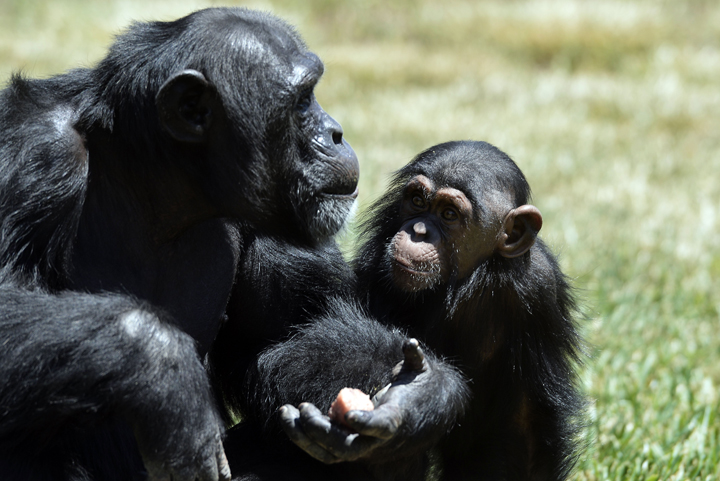
Japanese scientists have, for the first time, observed a chimpanzee caring for a severely disabled infant.

Chimpanzees are one of our closest living relatives (they share the distinction with bonobos). While they are very familial, no one has ever documented a case where a disabled infant was born into a family and then cared for — until now. This new discovery is helping researchers better understand how our own social behaviour may have developed during our evolution.
READ MORE: Primatologist Jane Goodall still educating the world about chimpanzees

Get daily National news
The female infant was born in Tanzania’s Mahale Mountains National Park with a severe disability similar to Down’s Syndrome. She also had a lump on her stomach, damage to her spine and a sixth finger.
The mother wouldn’t allow any non-relatives to care for her, but took on the responsibility of care herself (the researchers had observed previous instances where she would allow others to care for her young).
- Calgary area ‘very uniquely situated’ for study of hailstorms, says researcher
- New Asia Highlands exhibit, with some new species, opens at the Calgary Zoo
- Scientists find sugar in the Milky Way. It could help answer a cosmic mystery
- Meta to build $13 billion data centre in Alberta, largest outside the U.S.


Researchers believe that the infant lived for 23 months.
“One characteristic of human society is that people reasonably take care of the disabled and those in vulnerable positions,” researcher Michio Nakamura told the Japan Times. “It’s interesting to observe a chimpanzee looking after a disabled infant in terms of finding out when such sociality occurs, as they are the closest modern species to humans.”
The study was released in the journal Primates.


Comments
Want to discuss? Please read our Commenting Policy first.