


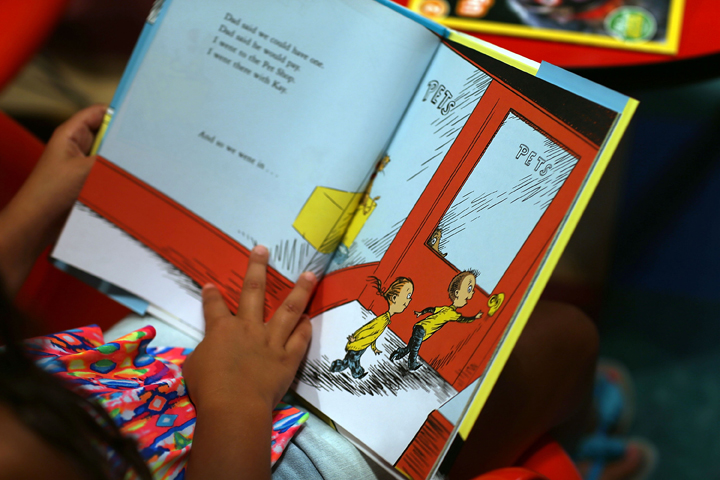
You can use math to calculate distances to other planets, or to build bridges or cars, but it turns out you can also use it to figure out what makes Dr. Seuss so fun.

Researchers from the University of Alberta have produced a study that figures out what tickles our funny bone — using math.
Of course, humour is typically subjective: not all of us find the same things funny. But these researchers have determined that there is a formula, and that it lies with letters, specifically, the mathematical measure of how predictable and ordered they are, called entropy.
The key lies in putting together letters that don’t typically go together, like with the word “finglam.” So the less likely the letters would be together, ie. less entropy, the sillier they seem.
- Calgary area ‘very uniquely situated’ for study of hailstorms, says researcher
- New Asia Highlands exhibit, with some new species, opens at the Calgary Zoo
- Scientists find sugar in the Milky Way. It could help answer a cosmic mystery
- Meta to build $13 billion data centre in Alberta, largest outside the U.S.


“We did show, for example, that Dr. Seuss—who makes funny non-words—made non-words that were predictably lower in entropy,” said Chris Westbury, a University of Alberta psychology professor and lead author of the study. “It essentially comes down to the probability of the individual letters. So if you look at a Seuss word like yuzz-a-ma-tuzz and calculate its entropy, you would find it is a low-entropy word because it has improbable letters like Z.”
The study first asked subjects to compare two non-words and choose the one they thought were the funniest. Then they were shown just one non-word and rated how humorous it was on a scale of 1 to 100.

Get daily National news
The researchers found that the bigger the difference in entropy between the two words, the more likely the subjects would pick the word they expected them to. It was so successful that they chose “correctly” about 92 per cent of the time.


Comments
Want to discuss? Please read our Commenting Policy first.