


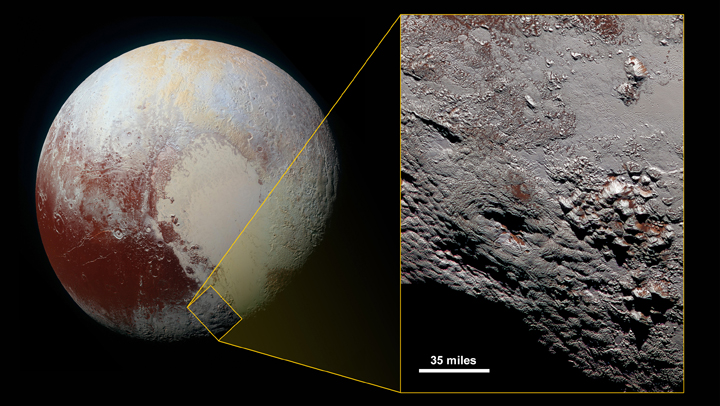
It’s a volcano unlike any you’ve ever seen.

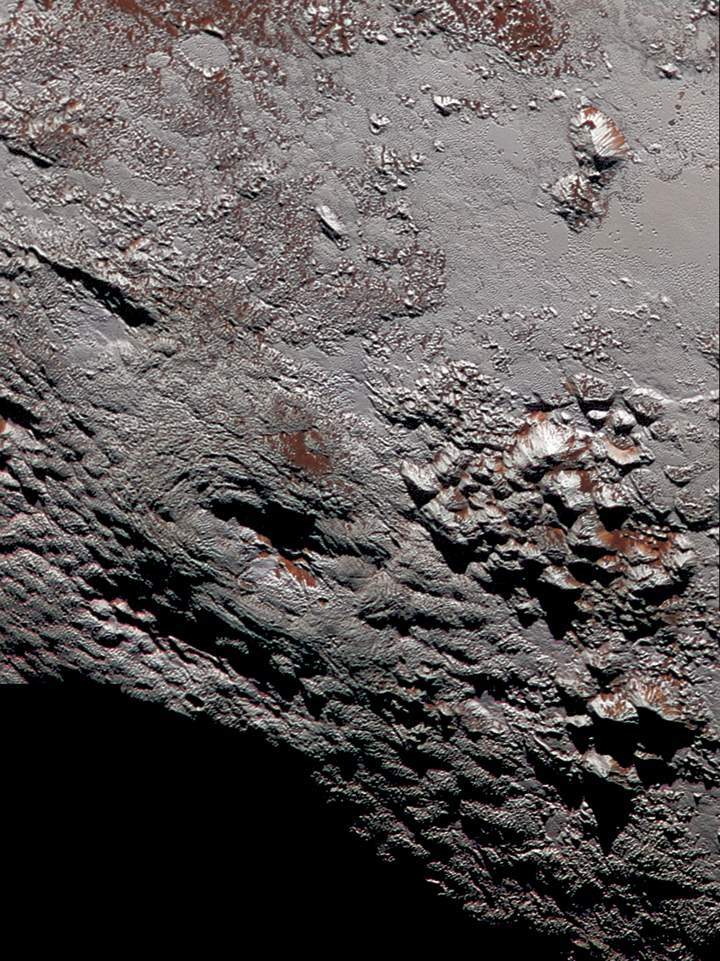
Wright Mons, south of the feature known as Sputnik Planum on the surface of Pluto, is one of two possible volcanoes on the dwarf planet. These volcanoes — known as cryovolcanoes — aren’t spewing out lava, but rather icy material, such as ammonia and nitrogen.
READ MORE: Pluto’s atmosphere seen in beautiful high definition
The volcano — named in honour of the Wright Brothers — was spotted on July 14, 2015, after NASA’s New Horizons spacecraft made its closest fly-by of the dwarf planet.
- Calgary area ‘very uniquely situated’ for study of hailstorms, says researcher
- New Asia Highlands exhibit, with some new species, opens at the Calgary Zoo
- Scientists find sugar in the Milky Way. It could help answer a cosmic mystery
- Meta to build $13 billion data centre in Alberta, largest outside the U.S.


Wright Mons is about 150 km across and four kilometres high. Though planetary scientists have yet to confirm whether or not it is indeed a cryovolcano, if it is, it would be the largest in the outer solar system (it’s believed that Titan, Saturn’s largest moon, is also home to cryovolcanoes).
READ MORE: U.S. Postal Service issues Pluto, New Horizons stamp

Get breaking National news
Pluto continues to intrigue scientists and Wright Mons is no exception: the scare distribution of the red material — believed to be tholins, soot-like, organic material and other compounds are exposed to ultraviolet light — around the area is perplexing, as is the fact that there is only one crater.


Comments
Want to discuss? Please read our Commenting Policy first.