


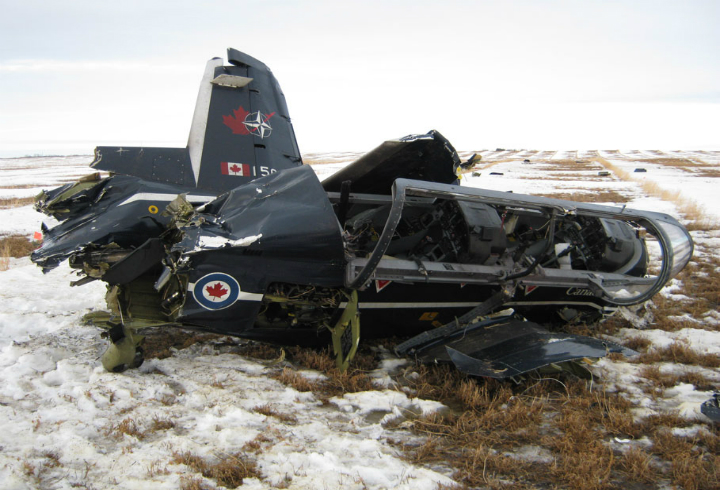
REGINA – A change in a training plan made to accommodate more military pilots was one of the factors in a 2014 Royal Canadian Air Force (RCAF) plane crash in Moose Jaw, Sask., according to a report by the Department of National Defence.

On Jan. 24, 2014, a Harvard II aircraft flying out of a Canadian Forces Flying Training School crashed near the city.
A student pilot and a flight instructor ejected and sustained minor injuries. The aircraft was destroyed when it crashed in an empty field.
A report on the incident, released on April 27, 2016, revealed that while the aircraft was fully serviceable and the crew members were qualified, there were contributing factors that may have led to the crash.
The report examined training plan developments. At the time, 15 Wing RCAF training headquarters in Moose Jaw was asked to produce 125 new graduates per year using existing allocated resources.
As a result, a revised training plan was created. One of the changes in the training was a 45 per cent reduction in missions that could include practice/precautionary forced landing (or emergency landings) practice.

Get daily National news
According to the report, the investigation found that the reduction wasn’t recognized and therefore, measures like applying more restrictive limitations to practice/precautionary forced landings was not developed.
Weather conditions were another factor that was examined in the report. During a practice emergency landing earlier in the day, the student pilot and the trainer had a “hard landing” amid strong winds.
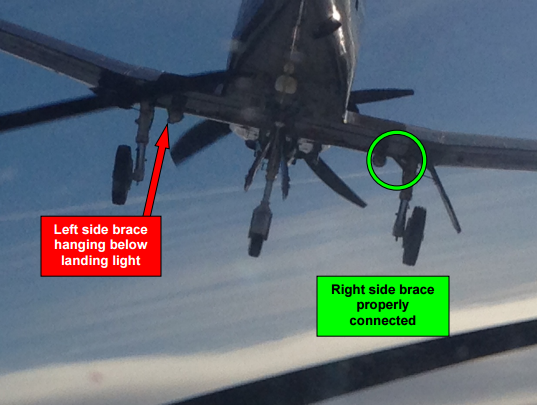
The landing gear and the nose of the plane touched the runway, but the instructor aborted the landing and went back up in the air. An indicator signaled that the landing gear was damaged and a chase plane confirmed.
The report said that the instructor applied a technique for the practice landing used in lighter windy conditions. The instructor was familiar with the technique for stronger winds but “relied on, was most conversant with and briefed only on the first technique.”
Other problems included a pre-flight briefing that only lasted 10 minutes instead of 30 minutes and when the plane rolled after the hard landing, a door fell off in close proximity to the chase plane.
Since the accident, the Royal Canadian Air Force has placed more restrictions on practicing emergency landings in windy conditions and changed the rules for landing planes with flaps down. This was considered a contributing factor in the crash.




Comments
Want to discuss? Please read our Commenting Policy first.