

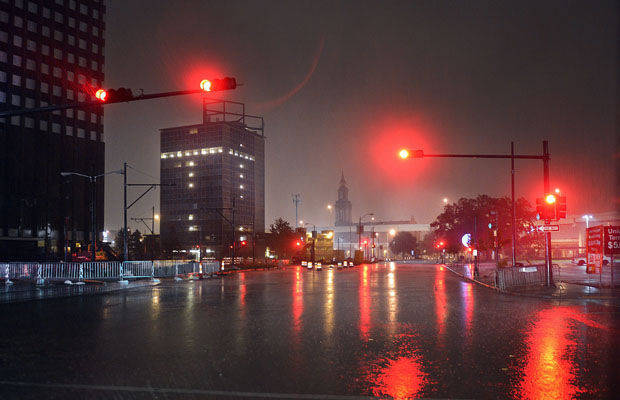
NEW ORLEANS – Hurricane Isaac slammed into the southern Louisiana coast late Tuesday, sending floodwaters surging and unleashing fierce winds, as residents hunkered down behind boarded-up windows. New Orleans calmly waited out another storm on the eve of the devastating Hurricane Katrina’s seventh anniversary, hoping the city’s strengthened levees will hold.

Isaac, a massive Category I hurricane spanning nearly 320 kilometres from its centre, made landfall at about 6:45 p.m. local time near the mouth of the Mississippi River. But it was zeroing in on New Orleans, about 145 kilometres to the northwest, turning streets famous for all-hours celebrations into ghost boulevards.
While many residents stayed put, evacuations were ordered in low-lying areas of Louisiana and Mississippi, where officials ordered the closure of the state’s 12 shorefront casinos. By late Tuesday, more than 100,000 homes and businesses had lost power.
Ed Rappaport, deputy director of the National Hurricane Center, said Isaac’s core would pass west of New Orleans with winds close to 130 kph and head for Baton Rouge.
“On this course, the hurricane will gradually weaken. Its winds will come down,” Rappaport said Tuesday night from the Miami-based centre. He said gusts could reach about 100 mph (160 kph) at times, especially at higher levels which could damage high-rise buildings in New Orleans.
As Isaac neared the city, there was little fear or panic. With New Orleans’ airport closed, tourists retreated to hotels and most denizens of a coastline that has witnessed countless hurricanes decided to ride out the storm.
“Isaac is the son of Abraham,” said Margaret Thomas, who was trapped for a week in her home in New Orleans’ Broadmoor neighbourhood by Katrina’s floodwaters, yet chose to stay put this time. “It’s a special name that means ‘God will protect us’.”
Still, the storm drew intense scrutiny because of its timing – just before the anniversary of Katrina and coinciding with the first major speeches of the Republican National Convention in Tampa, Florida, already delayed and tempered by the storm.
“We don’t expect a Katrina-like event, but remember there are things about a Category 1 storm that can kill you,” New Orleans Mayor Mitch Landrieu said, urging people to use common sense and to stay off any streets that may flood.

Get breaking National news
Other officials, chastened by memories and experience, advised caution. Tens of thousands of people were told to leave low-lying areas, including 700 patients of Louisiana nursing homes. At least one tornado spun off of Isaac in Alabama, but there were no immediate reports of damage or injuries.
Many Gulf Coast residents opted to ride it out in shelters or at home. Officials, while sounding alarm about the dangers of the powerful storm, decided not to call for the mass evacuations like those that preceded Katrina, which packed 217 kph winds in 2005.
Isaac promises to test a New Orleans levee system bolstered after the catastrophic failures during Katrina. But in a city that has already weathered Hurricane Gustav in 2008, calm prevailed as residents sized up the threat.
“I feel safe,” said Pamela Young, who settled in to her home in the Lower 9th Ward – a neighbourhood devastated by Katrina – with her dog Princess and television, waiting for the storm. “Everybody’s talking ‘going, going,’ but the thing is, when you go, there’s no telling what will happen. The storm isn’t going to just hit here.”
Young, who lives in a new, two-story home built to replace the one destroyed by Katrina, said she wasn’t worried about the levees.
“If the wind isn’t too rough, I can stay right here,” she said, tapping on her wooden living room coffee table. “If the water comes up, I can go upstairs.”
While Isaac remained far less powerful than Katrina, it posed similar political challenges, a reminder of how the storm seven years ago became a symbol of government ignorance and ineptitude.
President Barack Obama sought to demonstrate his ability to guide the nation through a natural disaster and the region’s Republican state officials reassured residents they were prepared, all the while readying for the coronation of Mitt Romney. It was unclear Tuesday, what effect the storm might have on the festivities in Tampa, where the candidate’s wife Ann Romney and New Jersey Gov. Chris Christie are the night’s featured speakers, after a day of delays.
There was already simmering political fallout from the storm. Republican Gov. Bobby Jindal, who cancelled his trip to the convention in Tampa, said the Obama administration’s disaster declaration fell short of the federal help he had requested. Jindal said he wanted a promise from the federal government to be reimbursed for storm preparation costs.


“We learned from past experiences, you can’t just wait. You’ve got to push the federal bureaucracy,” Jindal said.
Federal Emergency Management Agency Administrator Craig Fugate said such requests would be addressed after the storm.
“We wanted to make sure direct federal assistance got out first,” Fugate said.
Obama promised that Americans will help each other recover, “no matter what this storm brings.”
“When disaster strikes, we’re not Democrats or Republicans first, we are Americans first,” Obama said at a campaign rally at Iowa State University. “We’re one family. We help our neighbours in need.”
While politicians from both parties were careful to show their concern for those in the storm’s path, Gulf residents and visitors tried to make the best of the situation on the ground.
In New Orleans’ French Quarter, Hyatt hotel employee Nazareth Joseph braced for a busy week and fat overtime paychecks. Joseph said he was trapped in the city for several days after Katrina and helped neighbours escape the floodwaters.
“We made it through Katrina; we can definitely make it through this. It’s going to take a lot more to run me. I know how to survive,” he said.
Tourists seemed to be taking Isaac in stride.
Maureen McDonald of Long Beach, Indiana, strolled the French Quarter on her 80th birthday wearing a poncho and accompanied by family who travelled from three different cities to meet her in New Orleans to celebrate.
“The storm hasn’t slowed us down. We’re having the best time.”
But farther east along the Gulf, veterans of past hurricanes, made sure to take precautions.
At a highway rest stop along Alabama’s I-10, Bonnie Schertler, 54, of Waveland, Mississippi, summed up her decision to leave her home on the coast for her father’s home in Red Level, Alabama after hearing forecasters warning that the storm could get stronger and stall.
“I left because of the ‘coulds,”‘ said Schertler, whose former home in Waveland was destroyed in Hurricane Katrina. “I just feel like the storm may stay for a few days and that wind might just pound and pound and pound and pound,” she said.
—
This story was reported by Associated Press writers Cain Burdeau in New Orleans, Kevin McGill in Houma, Louisiana, Holbrook Mohr in Waveland and Pass Christian, Mississippi., and Jeff Amy reported from Biloxi and Gulfport, Mississippi., Jay Reeves in Gulf Shores, Alabama, Jessica Gresko in Coden, Alabama, and Julie Pace in Ames, Iowa.


Comments
Want to discuss? Please read our Commenting Policy first.