

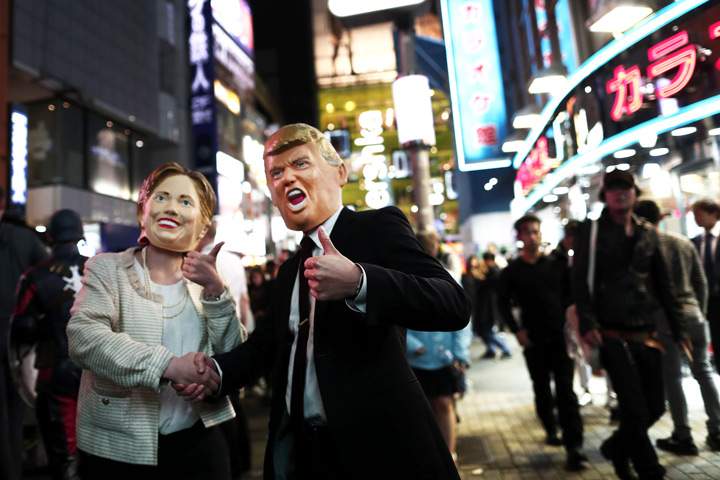
People in Japan and China are closely watching the progress of the American election.

In Japan, Prime Minister Shinzo Abe has told an aide that “the competition is closer than expected” in the U.S. election. Aide Tateo Kawamura told Japan’s Kyodo News service that Abe is following the vote count in his office.
The Japanese government has remained neutral in public statements, but analysts on both sides of the Pacific have talked about a possible change in U.S. policy toward Japan and the rest of Asia if Republican candidate Donald Trump should win.
Chief Cabinet Secretary Yoshihide Suga reaffirmed his government’s commitment to the U.S.-Japan security alliance. He told reporters that whoever is the next president, the Japan-U.S. alliance will remain the cornerstone of Japan-U.S. diplomacy.

The Japanese Nikkei 225 market index dropped 2.2 per cent in response to the increasing likelihood of a Donald Trump presidency, and market benchmarks in Hong Kong, South Korea and Australia also fell by similar amounts.
READ MORE: Markets plunge with increasing chance of Donald Trump victory
WATCH: Global National’s Dawna Friesen and Tom Clark discuss Asian markets and the election

Japanese people are also following the results, though not all of them want to.

Get daily National news
One Twitter user complained, “The U.S. presidential election is the only thing I can see on any channel!”
Several major television stations suspended their regular morning programming to cover the vote, with a running tally of results and explanations of the U.S. electoral vote system.
China for Trump
Chinese media are also watching the election, though they have a different take on events.
Chinese state media outlets are casting the U.S. election as the embodiment of America’s democracy in crisis in contrast to China’s perceived stability under authoritarian rule.
The state-run Xinhua News Agency said the campaign has highlighted that, in its words, “the majority of Americans are rebelling against the U.S.’s political class and financial elites.”


The official Communist Party newspaper People’s Daily says in a commentary that the presidential election reveals an “ill democracy.”
READ MORE: Live real-time results
On Tuesday, the Chinese state broadcaster CCTV ran man-on-the-street interviews with unidentified American voters in which they expressed disgust with the system and dissatisfaction with both candidates.
Chinese state media and government-backed commentators have also signalled Beijing’s preference for a Donald Trump win in the U.S. presidential election, though media haven’t always agreed with what he said.
READ MORE: Chinese news agency slams Donald Trump for ‘China-bashing’
Like Russia, China is seen as favouring Trump because he appears less willing to confront China’s newly robust foreign policy, particularly in the South China Sea. Clinton, by contrast, is disliked in Beijing for having steered the U.S. “pivot” to Asia aimed at strengthening U.S. engagement with the region, particularly in the military sphere.
Writing in the Communist Party newspaper Global Times, scholar Mei Xinyu said, “From a comprehensive view, it would make it easier for China to cope if Trump is elected. This is because under the policy line advocated by Obama and Clinton, the political and military frictions between China and the U.S. will be more frequent.”

-
![]() Donald Trump supporters chant ‘USA, USA’ after Florida victory
Donald Trump supporters chant ‘USA, USA’ after Florida victory -
![]() US Presidential Election 2016: Clinton supporters stunned as results roll in
US Presidential Election 2016: Clinton supporters stunned as results roll in -
![]() Donald Trump campaign HQ erupts in cheers as Trump declared winner in Florida
Donald Trump campaign HQ erupts in cheers as Trump declared winner in Florida -
![]() Trump’s wins in battleground states making for tighter race than expected
Trump’s wins in battleground states making for tighter race than expected -
![]() Donald Trump’s results have experts shocked
Donald Trump’s results have experts shocked -
![]() Hillary Clinton is going to have to win Michigan and New Hampshire
Hillary Clinton is going to have to win Michigan and New Hampshire -
![]() Florida, North Carolina goes to Trump; Colorado and Virginia head to Clinton
Florida, North Carolina goes to Trump; Colorado and Virginia head to Clinton -
![]() Donald Trump campaign HQ reacts to news of Ohio win
Donald Trump campaign HQ reacts to news of Ohio win -
![]() US financial leader in Japan says Trump presidency would worry Asian market
US financial leader in Japan says Trump presidency would worry Asian market -
![]() Canadian citizen and immigration website crashing during U.S. election
Canadian citizen and immigration website crashing during U.S. election -
![]() Prospect of Trump presidency sends world markets plunging
Prospect of Trump presidency sends world markets plunging -
![]() Sarah Palin spotted mingling at Trump campaign HQ
Sarah Palin spotted mingling at Trump campaign HQ -
![]() Trump wins Ohio, edging closer to presidency; Clinton wins Virginia
Trump wins Ohio, edging closer to presidency; Clinton wins Virginia -
![]() Donald Trump jumps biggest hurdle, wins Florida
Donald Trump jumps biggest hurdle, wins Florida -
![]() Hillary Clinton ‘taking on water’ as polling numbers favour Trump
Hillary Clinton ‘taking on water’ as polling numbers favour Trump -
![]() New York goes to Clinton while Trump takes Texas; waits for key states
New York goes to Clinton while Trump takes Texas; waits for key states


U.S. Ambassador to China Max Baucus said “the world’s most important relationship” between Beijing and Washington will remain stable regardless of the outcome of the U.S. presidential election.
Asked by a Chinese reporter about Trump’s proposal for a 45 per cent tariff on Chinese goods imported in the U.S., Baucus said that “people say a lot of things in the heat of a campaign that are not quite as feasible as they think when they’re elected.”
Trump has also pledged to withdraw U.S. support for the Paris climate change agreement that was reached largely through hard negotiating with China.
Baucus said he doesn’t believe the two countries would stop collaborating on issues already agreed to, including climate change, containing North Korea’s nuclear ambitions and reaching a political settlement in Afghanistan.
In his words, “The issues are the same, the good faith is the same.”


Comments
Want to discuss? Please read our Commenting Policy first.