


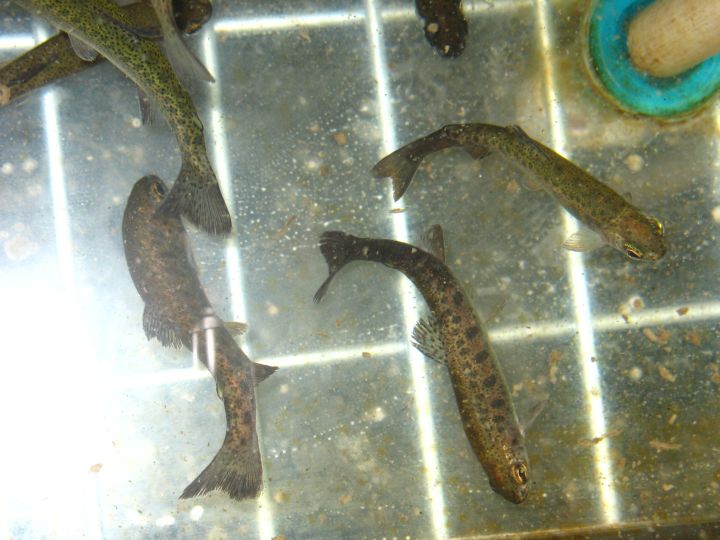
Whirling disease has been detected in fish in the Crowsnest River, according to the Canadian Food Inspection Agency (CFIA).

The infectious disease deforms and cripples young fish by penetrating the heads and spines of salmanoids like salmon, trout, whitefish and char.
The microscopic parasite eats away at cartilage in fish skulls, causing fish to swim erratically — or whirl. The whirling makes it difficult for the fish to feed and avoid predators. The fish also usually die prematurely.

Get breaking National news
The disease isn’t harmful to humans or other animals that consume infected fish.
The CFIA says whirling disease was detected on April 4 at three locations within the Crowsnest River — at the confluence of Crowsnest River and Todd Creek, downstream from the Highway 3 bridge near Lundbreck and upstream from the confluence of Crowsnest River and Rock Creek.
The first Canadian case of whirling disease was found in fish in Banff National Park’s Johnson Lake in August 2016.
- Calgary area ‘very uniquely situated’ for study of hailstorms, says researcher
- Memorial tree at Saskatoon cemetery to be cut down due to invasive disease
- ‘Sovereignty comes with responsibility:’ U.S. lawmakers to Canada on wildfires
- Bow Glacier Falls Trail, site of two deaths in 2025 rock slide, reopens to hikers
-
![]() Ontario wildfires: Residents evacuate devastated Collins First Nation as infrastructure wiped out
Ontario wildfires: Residents evacuate devastated Collins First Nation as infrastructure wiped out -
![]() Health alerts issused as wildfire smoke continues to blanket Peterborough region
Health alerts issused as wildfire smoke continues to blanket Peterborough region -
![]() Northwestern Ontario wildfires burn buildings, trigger evacuations
Northwestern Ontario wildfires burn buildings, trigger evacuations -
![]() City of Calgary could approve more than 17 thousand new homes by 2030
City of Calgary could approve more than 17 thousand new homes by 2030


In February of this year, the CFIA confirmed fish in the Bow River, a renowned Alberta trout stream, had also been infected by the disease.
The disease is spread between waterways by fish themselves, or recreational equipment used in the rivers and lakes for fishing, boating, paddling and swimming.
The CFIA says the confirmation of the disease in the Crowsnest River don’t necessarily mean it’s spreading, saying it could have been in the waterway undetected for many years.


Comments
Want to discuss? Please read our Commenting Policy first.