


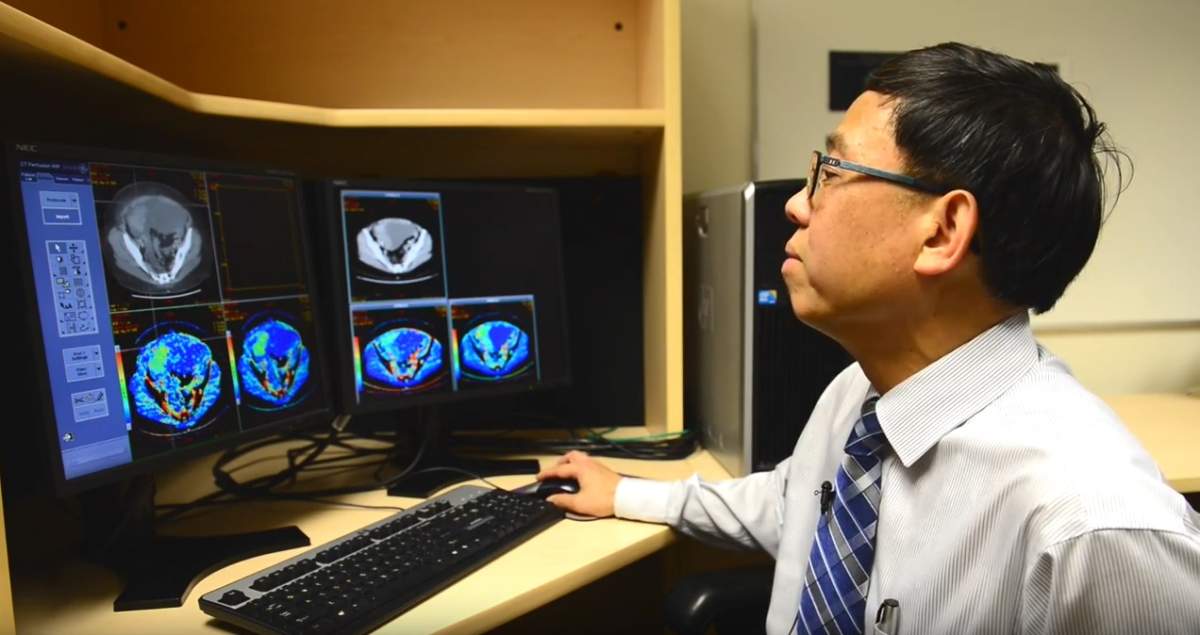
Researchers at Western University and Lawson Health Research Institute say a simple CT scanning procedure can show whether patients are responding to treatment for advanced ovarian cancer.

With help from his team at Robart Research Institute, Western University professor Ting-Yim Lee developed the CT perfusion technology, which measures blood flow and blood volume to ovarian cancer tumours.
“We’re looking at whether — before and after treatment — there is an increase in the blood flow in the ovarian cancer, or if there is a decrease,” Lee told AM980. He’s also a scientist at Lawson Health Research Institute and a medical physicist at St. Joseph’s Health Care London.

Get weekly health news
READ MORE: Western University study shows promise for earlier dementia diagnoses
This information allows an oncologist to determine whether a treatment plan is working, and allows them to change course if it isn’t. It would also spare a patient from unnecessary adverse effects.
The technology is already used globally to assess blood flow to the brain on patients who’ve had a stroke, and it’s easily implemented onto an existing CT scanner.
- Ontario school boards record more deficits a year after supervisors sent in
- Ontario education minister ‘clarifying’ students will be allowed to miss class for sports
- Ontario education minister urges parents not to pull kids from school for sports
- Saskatchewan NDP urges province to repeal pronoun law affecting LGBTQ+ youth


READ MORE: Western University students make their mark on Mars
While the results of the study — published in the journal Clinical Cancer Research — are promising, Lee said more research is necessary before the practice becomes a guideline.
“In order to gather more evidence so that it becomes a Level 1 evidence … you need other similarly designed trials to produce a similar effect.”
Lee says the technology has been in development in his lab for more than a decade.
The multi-centre clinical trial was funded by the US National Cancer Institute and took place at 19 centres in the United States.


Comments
Want to discuss? Please read our Commenting Policy first.