






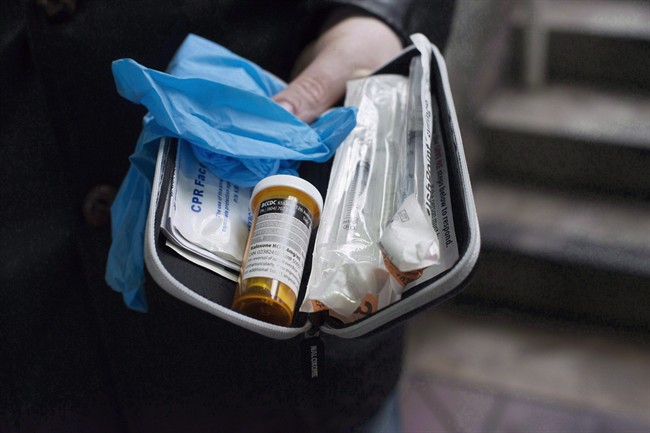
If and when London opens a supervised consumption site, Middlesex-London’s medical officer of health says it will not be located on Dundas Street.

Dr. Chris Mackie said the request, which comes from the Old East Village Business Association, is a reasonable one.
“It’s a major route, there’s a lot of commercial activity. It wouldn’t necessarily be an ideal fit.”
Despite a commitment to avoid Dundas Street, Mackie said Old East Village is still one of the locations being considered for a supervised consumption site, along with the downtown core, SoHo, and a stretch of Hamilton Road that sees injection-drug use activity.
As the community consultation phase on the project draws to a close, Mackie hopes to see one or two facilities in the next one or two years, with a goal of getting three or four further in the future.
Discussions around the table at a variety of public meetings over the past few weeks have raised legitimate concerns said Mackie, with questions about drawing drug users and dealers into an area, increasing public injecting behaviour and creating needle waste.

Get weekly health news
“The research shows that generally doesn’t happen. In fact, you tend to see improvements in public order,” he explained.


But residents are also raising other concerns, such as whether the city has supporting services like treatment, detox and rehab services.
“Are we going to have a facility that’s going to be accessible to the people that need it most… so that it can have the most impact on the drug crisis that we’re seeing?”
In order to help the most people, Mackie discussed a need to establish the facility in a place where it would solve problems, rather than create them.
“We’re looking for the places that have the most drug activity, we have some indicators of that in terms of needle waste, in terms of where people live who are turning up positive for hepatitis C, which is associated with drug use generally.”
The Centre for Organizational Effectiveness will be doing data analysis on information gathered by the community consultation phase. Meanwhile, Mackie hopes to get federal exemption and provincial funding applications filled out and submitted by January, while simultaneously working on the municipal zoning process.


Comments
Want to discuss? Please read our Commenting Policy first.