


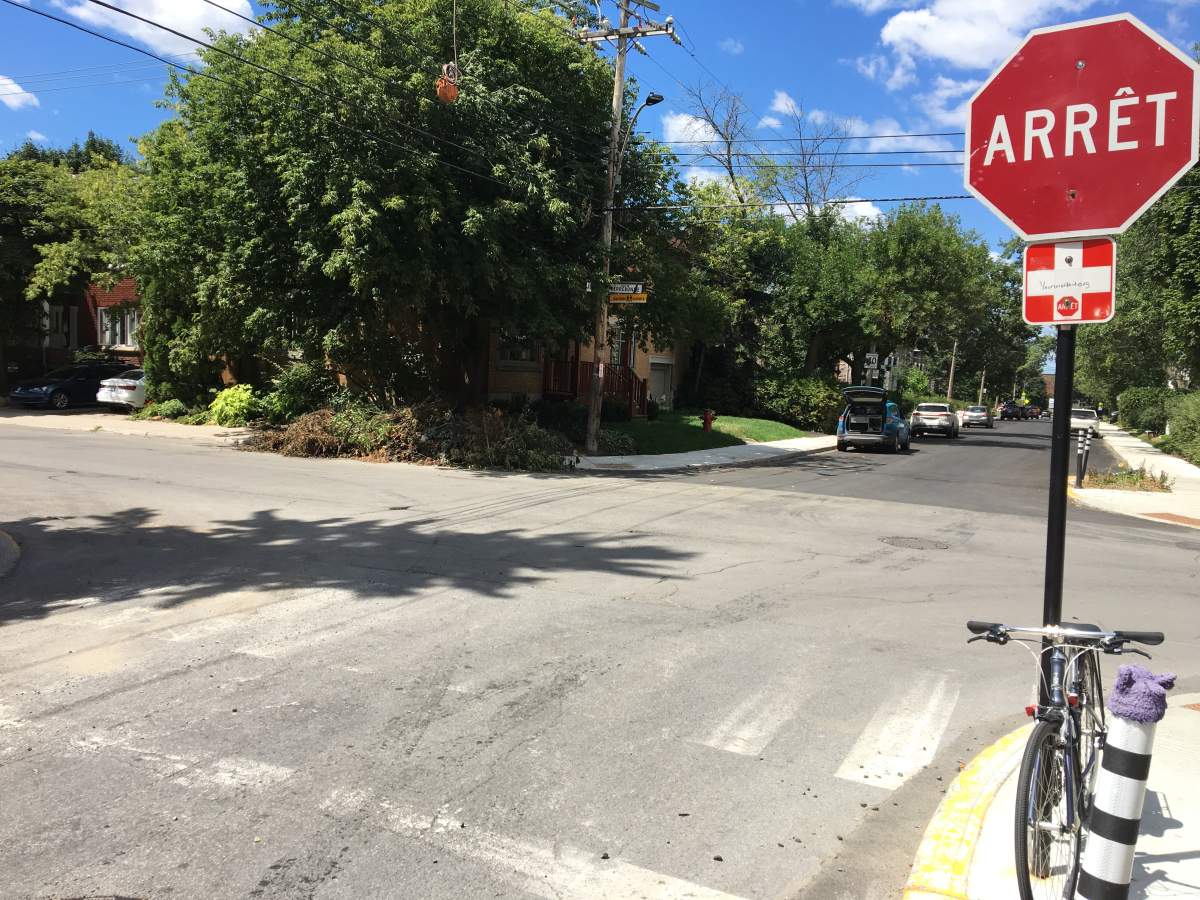
The City of Montreal has adopted a motion aimed at improving line-painting on city streets.

And while it may seem like a little thing to some, city Coun. Marvin Rotrand — who tabled the motion — begs to differ.
“It’s a basic, fundamental city service,” he said. “It doesn’t cost a lot, but it has a big impact in terms of traffic control, pedestrian safety and cyclist safety.”
Adopted by city council on Monday evening, the new motion will have four main points.
First off, the city will commission a study on how to improve service.
Under the current system, the borough of Rosemont-La-Petite-Patrie is responsible for line-painting in the nine central wards of the city, including Rotrand’s borough of Côte-des-Neiges–Notre-Dame-de-Grâce.
READ MORE: Montreal city councillor calling for overhaul of line-painting on city streets
Get daily National news
Rotrand has qualified the service there as “atrocious.”
“The Canadian norm is to get it done early in the season, end of May, beginning of June,” he told Global News. “Here we are mid-August and we’re not finished.”
The city, according to Rotrand, blames a lack of resources to deal with an increased workload.
For Rotrand, part of the problem stems from the cyclical nature of the work.
“What usually happens is we paint in August and winter comes and the type of paint we use disappears by March, April, and you’ve got to start all over again,” he said. “It’s a cycle that doesn’t give value for money for the citizen.”
Montreal has agreed to look into new products and new paints that are more resistant and will last longer.
- 2 Saskatchewan research farms to stay open as province enters MOU with Ottawa
- How Canada helped in past U.S. wildfires as Ford says some are ‘chirping’
- Nenshi seeks Calgary seat in next election as Estabrooks vies for Edmonton-Strathcona
- Ontario MPP and sport minister announces retirement from politics


WATCH: Outremont tests out 3D crosswalk in hopes of slowing down drivers

The city has also agreed to explore new partnerships to ease the load for blue-collar workers.
“We’re looking at the possibility of bringing in private enterprise,” Rotrand said, adding that a mix of private and blue-collar workers was also a possibility.
The final point on the motion was to give greater priority to crosswalks — meaning that they should be painted before other types of traffic lines in order to protect the most vulnerable road users.


Comments
Want to discuss? Please read our Commenting Policy first.