


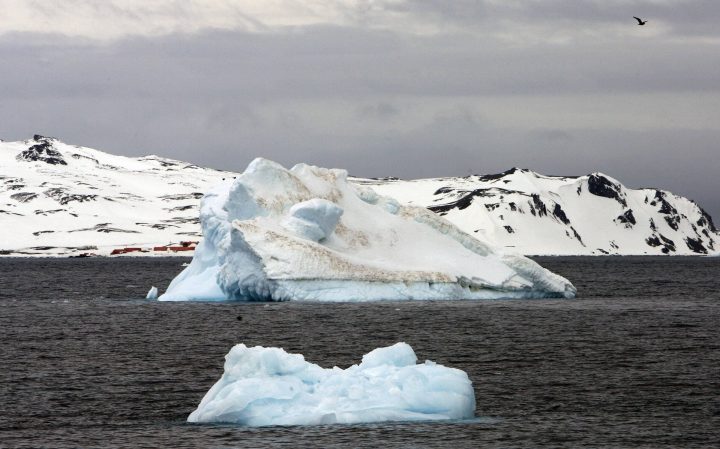
TORONTO – A group of British scientists have found evidence of diverse life in a subglacial lake dating back almost one hundred thousand years.

Scientists made the discovery while drilling near Lake Hodgson on the Antarctic Peninsula.
The area was covered by more than 400 m of ice at the end of the last Ice Age, but now only has a thin covering of ice just three to four metres thick, creating an emerging subglacial lake.

Get breaking National news
The scientists drilled through the lake and then, using clean coring techniques, drilled into the sediments of the lake bottom.
Though it was thought that the lake was too harsh an environment for life, the layers of mud the scientists found preserved the DNA of microbes that have lived there for millennia. The top few centimetres had current and recent organisms, but at the bottom – 3.2 m deep – the microbes they found dated back nearly 100,000 years.
- Calgary area ‘very uniquely situated’ for study of hailstorms, says researcher
- New Asia Highlands exhibit, with some new species, opens at the Calgary Zoo
- Scientists find sugar in the Milky Way. It could help answer a cosmic mystery
- Meta to build $13 billion data centre in Alberta, largest outside the U.S.


“The fact these organisms have survived in such a unique environment could mean they have developed in unique ways which could lead to exciting discoveries for us. This is the early stage and we now need to do more work to further investigate these life forms.”
Organisms that live in harsh environments are called extremophiles.
Scientists hope that understanding how these extremophiles survive might lead to discovery of life on other planets or moons in our solar system.


Comments
Want to discuss? Please read our Commenting Policy first.