


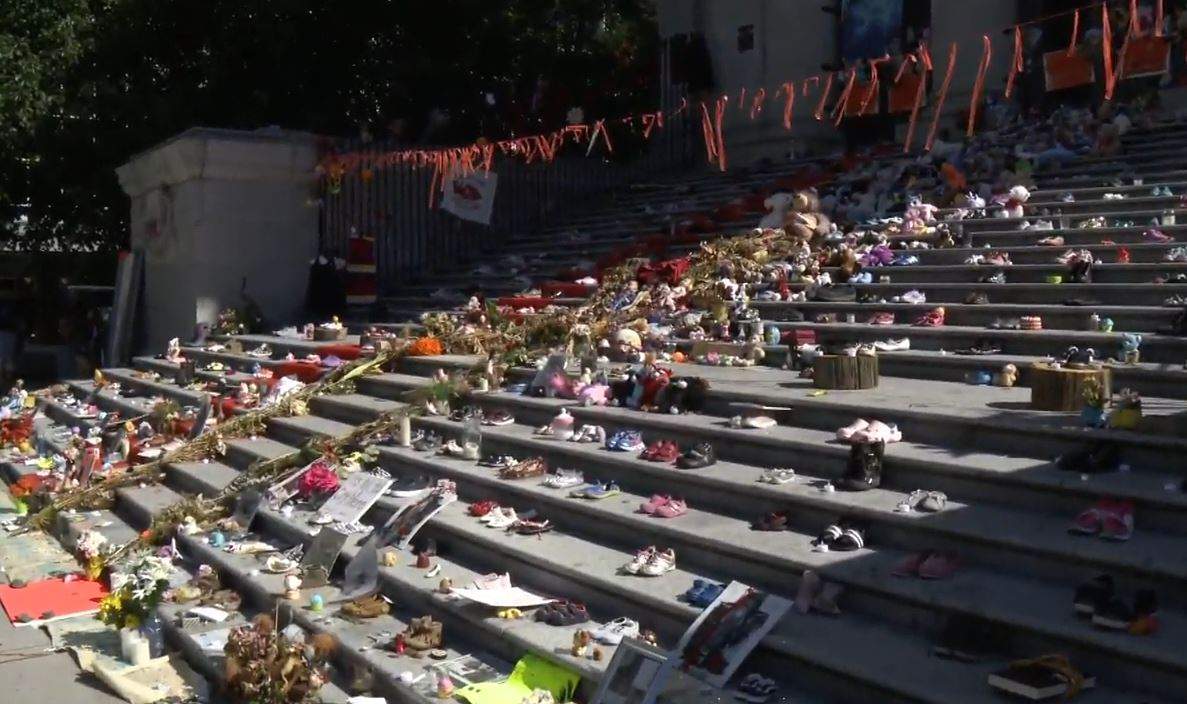
A memorial to the Indigenous children who never made it home from residential school has been lining the steps of the Vancouver Art Gallery for the past two years.

The memorial went up in May 2021, after Tk’emlúps te Secwe̓pemc discovered the suspected unmarked graves of 215 children at the site of the former Kamloops Indian Residential School.
Haida artist Tamara Bell set down 215 pairs of shoes on the steps, one for each child.
Since then, volunteers have been looking after the memorial.
Now, almost two years later, the City of Vancouver, with support from xʷməθkʷəy̓əm (Musqueam), Sḵwx̱wú7mesh (Squamish), and səlilwətaɬ (Tsleil-Waututh) Nations, has asked for the temporary residential school memorial to come down.
“It became a place of grieving and healing for many Indigenous Peoples, including residential school survivors, and a place for non-Indigenous people to learn and pay respects to the children who died at residential schools across Canada,” the city said in a statement.


The city said it is making the request because the local First Nations were not formally consulted or asked for permission, and according to the cultural protocols of the xʷməθkʷəy̓əm (Musqueam), Sḵwx̱wú7mesh (Squamish) and səlilwətaɬ (Tsleil-Waututh) Nations, memorials are meant to be temporary in nature.
Get breaking National news
“Reconciliation is a learning journey, and the City acknowledges its own misstep in not acting earlier to observe the rights and titles and cultural protocols of the local Nations due to the sensitive nature of the temporary residential schools memorial,” the city said.
- B.C. First Nation banishes 5 members who pose serious safety risk
- Road to the Referendum: First Nation chiefs fighting Alberta separatism to preserve way of life
- B.C. First Nation upset over shortened park closure dates
- B.C. First Nation marks 5 years since potential burial sites found on grounds of former school


Staff has been in contact with Bell and the volunteers and they will work together to establish a process of bringing the memorial to a close over the coming months, which will be a private matter.
“The City is committed to working with the xʷməθkʷəy̓əm (Musqueam), Sḵwx̱wú7mesh (Squamish), and səlilwətaɬ (Tsleil-Waututh) Nations, and Urban Indigenous communities, on all future planning for such spaces,” the city said.
The Indian Residential Schools Crisis Line (1-866-925-4419) is available 24 hours a day for anyone experiencing pain or distress as a result of their residential school experience.


Comments
Want to discuss? Please read our Commenting Policy first.