

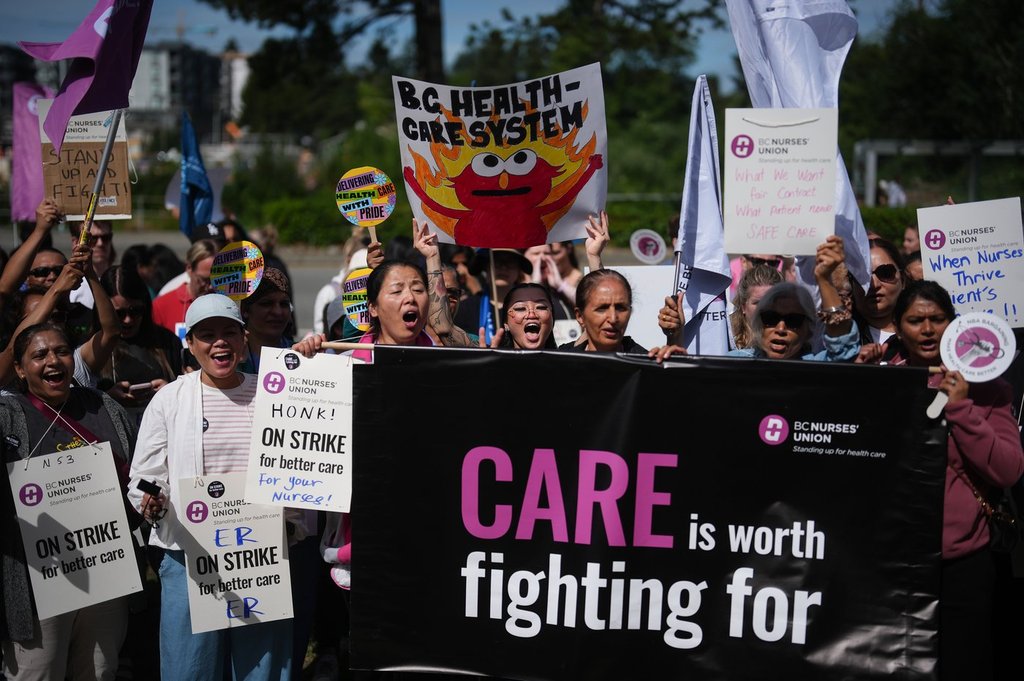
Veteran mediator Vince Ready has been appointed to try to help settle the British Columbia nurses’ dispute as the union steps up its job action.

Labour Minister Jennifer Whiteside said in a statement on Friday that Ready and Amanda Rogers will act as special mediators to work with the parties for 10 days to help try to reach a settlement.
The statement says that if necessary, they will provide recommendations to the minister to end the dispute.
Ready has a long history in the province of troubleshooting some of the most fractious disputes.
Nurses announced on Thursday that they would step up their job action with an expansion of pickets to additional care centres across the province.
While many of the 60,000 unionized nurses are covered under essential-service agreements, those not on the job have been picketing in front of care centres in Surrey and Vancouver.

The union implemented targeted action last week with a ban on non-nursing duties and non-essential overtime.



Get weekly health news
Premier David Eby announced a mediator would be stepping into the dispute on Friday at an unrelated news conference in Prince George.
“I don’t want to prejudge any conversations that will take place at the table,” Eby said. “I know we have a shared goal of ensuring nurses are respected and appreciated in our system, and are able to return to work fully to support patients in British Columbia, and that will be our goal at the table.”
The labour dispute has drawn attention to nursing issues, such as working conditions and safety, among others, he said.
The premier said that while government has taken steps to try to mitigate some of those pressures, such as nurse-to-patient ratios and security, there are still issues that need to be addressed.
“Nurses are the glue that hold an incredibly strained system together, and they deserve to be recognized for that,” he said.
No one from the BC Nurses’ Union was immediately available to comment on the appointment of the mediators.


Hey Biff,
What about 60 plus days of summer vacation?
And 5 ProD days( paid study from home LOL)
Plus 11 public holidays.
Not to the last few days of every term where everyone mails it in.
So let’s do the math.
That’s 76 days off a year. Or 11 weeks. 52- 11 is 41 weeks.
Meaning if you averaged that out over a normal year round work week with only 2 or 3 weeks off a year.
Average work days a year 250.
So 250-76 =174 days a year of equivalent.
Not quite your average blue collar clock puncher is it?
But “ Guessing you were a bad student( or teach art, PE Shop
or indigenous studies) we get it.”
Let them stew a-bit,
I wonder if they are objective enough to ask themselves this.
If the province is already billions in debt where are they going to get more money to pay me.
Or is it you just don’t care?
Hey Biff,
Your obviously so hard done by just like the rest of your teaching colleagues who got the teaching job and retired the next day.
Hey Bill…rather ignorant, you are. As a public school tracher, I show up at 7, leave around 5:30. Do the math…almost equals a clock punching, blue collar worker’s hours. My nurse wife will never say it out loud, but she has a cushy gig. Not all nurses are in emergency or O.R., ya know. Guessing you were a bad student. I get it.
@ U KNOW IT
Don’t ever link nurses to teachers !!!
Nurses are hard working, dedicated and work long hours.
Teachers are lazy out for themselves and only work 5 hours a day for 7 months of the year.
NURSES AND TEACHERS ALWAYS TREATED LIKE F / G S H I T ! I’M SO F/ G TIRED OF IT
Time to change their contract so hard working nurses get rewarded and the scammers on full paid long term disability are weeded out.
The difference between nurses and other employees is that nurses save lives. Doctor’s wages are over $300k/year to start and that’s for a GP. Doctors diagnose the problem and the nurses implement and take care of the patients. Nurses on the front line (emergency , ICU, surgery, etc.), should be paid substantially more than employees for non-lifesaving jobs. All jobs are important, but people who save lives should be paid more.
Will the systemic practice of calling in sick so a cohort can pick up and extra shift for double time +…and the favour being returned be addressed?