


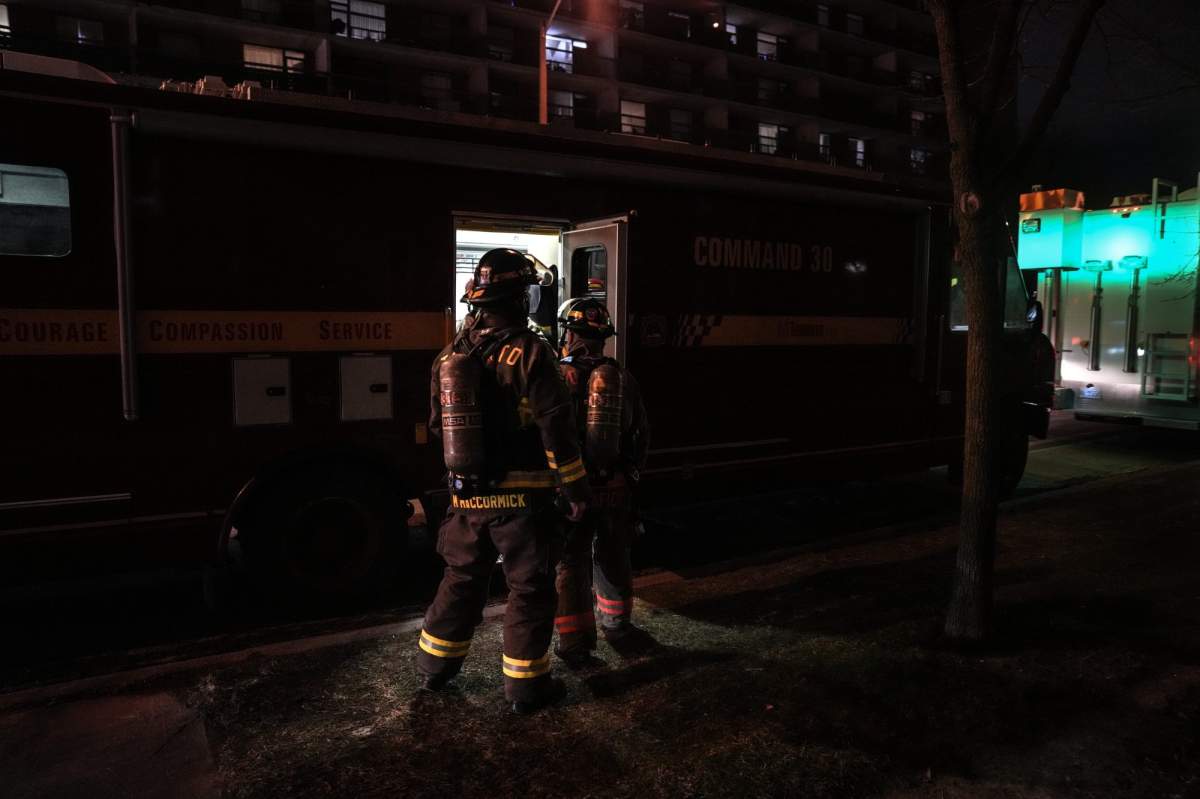
The amount of time it takes for firefighters to get to calls in Toronto is increasing as limited crews deal with increased calls in a gridlocked city.

Speaking to a Toronto committee, fire Chief Jim Jessop said the service faced an “ongoing challenge” when it comes to how quickly trucks are able to get to the scene of a fire.
“Toronto Fire Service continues to see an increase in travel time and total response time, which is an ongoing challenge influenced primarily by factors including call volume increase and unit availability to respond,” he said on Tuesday.
Travel times for trucks have been trending up for years.

Get breaking National news
Officially, Toronto Fire Services aims to spend no more than four minutes travelling to calls 90 per cent of the time, a target it has strayed further and further from in recent years.
Back in 2021, the average travel time was five minutes and 51 seconds. That has steadily increased to six minutes and 15 seconds in 2025, when Toronto Fire only achieved its target 53 per cent of the time.
Travel time, however, isn’t the only metric the service measures.
Call processing times have remained constant at just under a minute, while firefighters are getting significantly faster at their turnout time target.
- Montreal public health warns of overdose spike as naloxone use reaches last year’s total
- Saskatchewan boosts disaster aid in response to storm-packed spring and summer
- World champion curler, long-time broadcaster Don Duguid dies at 90
- Corus to centralize Calgary, Edmonton news production, some jobs cut
-
![]() Cyclospora outbreak source not confirmed, health officials investigating link to lettuce, greens
Cyclospora outbreak source not confirmed, health officials investigating link to lettuce, greens -
![]() CN rail train drives through inferno as wildfires ravage northwestern Ontario
CN rail train drives through inferno as wildfires ravage northwestern Ontario -
![]() WestJet flight attendants vote in favour of strike
WestJet flight attendants vote in favour of strike -
![]() Immigration lawyer reacts as some “Lost Canadians” told to return citizenship certificate
Immigration lawyer reacts as some “Lost Canadians” told to return citizenship certificate


Figures presented to Toronto councillors show the total response time for Toronto fire has remained relatively consistent at around seven minutes and 44 seconds last year — compared to seven minutes and 38 seconds in 2021.
“Call processing time, turnout time, travel time and total response time are key performance indicators for Toronto Fire Service and we measure against them,” Jessop said.
“Our overall goal is to be arriving on scene of an incident within six minutes and 24 seconds, 90 per cent of the time. “We have achieved that at 76 per cent of incidents in 2025.”
The report shows the total average time for firefighters to arrive after a call is placed is just under nine minutes, an improvement of 10 minutes and 40 seconds compared to five years ago.


has to happening in most major cites. I see it happen here in Kelowna all the time. Drivers here are affected with the Kelowna Ignorant bug or some such thing. They are by far the worst drivers ever and I’ve driven in a lot of places. The ME ME ME attitude is Kelowna to the T when it comes to driving.
Would this have anything to do with the pressure to build bike lanes, and remove multi-use lanes? Would it have anything to do with ‘traffic calming’ barriers, speed bumps.
The people insisting that we can all ride bicycles, have not thought about emergency vehicles, delivery trucks or busses.